Talk About The Passion #3 – Rage and Restraint

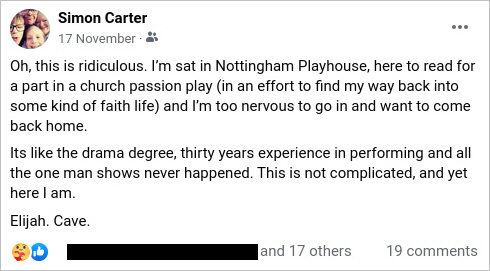
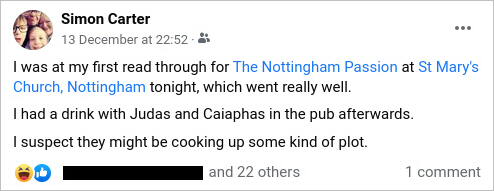
IF YOU’VE COME WITH ME this far and read previous instalments, you’ll know that I’m taking part in The Nottingham Passion theatre production at St Mary’s in the Lace Market this Easter. You’ll also know which role I’m playing, and that I’m finding this role to be quite the challenge.

This might sound odd, but I struggle to say the words: ‘I’ve been cast as Jesus.’

x Notts Passion Rehearsal Pic 12

I meant it when I wrote previously that being given the chance to portray Jesus was among the privileges of my life. It’s not been an easy experience so far, but with three weeks of rehearsals under my belt it feels like I’m finding my feet now. Fear and uncertainty have now given way to some self-confidence, though I worry that the Jesus voice which appears to be coming out of me sounds a bit like Russell Crowe in the movie Gladiator.

As rehearsals move into the church proper, and I stand there pretending to be him (not Russell Crowe, Jesus), and I try to articulate the utterly beautiful words he said (again not Russell Crowe, Jesus), I can’t believe it’s me who’s doing this. It doesn’t feel real yet. Maybe that’s why I struggle to say the words: ‘I’ve been cast as Jesus.’

Please don’t think these are just the outpourings of some blithering old luvvie. This is truly the way I’m feeling – and this next sentence is a simple, objective statement of fact.

Powerful stuff is happening in rehearsals right now.

Such. Powerful. Stuff.

And everyone feels it, I think. Not just me.

x Notts Passion Rehearsal Pic 16

I don’t know how to process it properly. I’ve been doing this performing arts thing for more than thirty years, and this is unlike anything I’ve ever done. I come away from rehearsals on a Tuesday and a Thursday feeling energised and exhausted, euphoric and numb, bewildered and clear-headed, filled up and empty. It feels like I don’t know what I’m doing but that I’ve never felt more ready. I’m a walking paradox.

The best I can manage right now when I speak about any of this to anyone out loud is: ‘I’ve been cast as a certain gentleman from Nazareth.’

And people go: ‘Oh. Jesus?

And I go: ‘Er. Yes.’

And people go: ‘That’s cool. How’s it going?’

And I go: ‘It’s complicated.’

Then I worry that if they read these blogs, they’ll avoid the subject next time they see me or avoid me in general, because they’ll think I’m a loony.

Oi! Keep that thought to yourself.

By way of recap, if you’ve read blog one, you’ll know all about where I am with my faith, and how being cast as Jesus has pushed me into trying to see (and show) how the events of Passion Week might have felt from the perspective of the central figure in all of it.

If you’ve read blog two, you’ll know something about what passion plays are, and read my take on how Jesus may have experienced the events of Palm Sunday, all this filtered through the lens of an honest performer seeking to tell his character’s story as truthfully as possible.

If you’ve read both blogs you’ll know that, while I’m a Christian, this series is aimed at anyone and everyone. You’ll know there are some rules of engagement too, designed to ensure that you and I make our way through this whole thing unscathed. Here are those rules again:

rule-1752536_1280

  1. I’m not going to try to answer all (any?) of life’s big questions for you, though I hope there may be something in what I’m writing which prompts you to explore some of these questions more deeply;
  2. I’m not going to preach to you – I have a faith, but this stuff is aimed at everyone, whatever their point of view;
  3. There is no pre-planned structure to this series which ends with me ‘seeing the light’ through my experience of playing Jesus. There’ll be no fluffy, gift-wrapped testimony from me at the end. That would be so twee, and perhaps a little cynical. So, to be clear. I genuinely don’t know how these pieces of writing will develop;
  4. I’m not about to get all ‘pretentious artist’ on you. I’m not that person, and I don’t do this acting lark for a living. I’m a part-time writer and performer who sincerely just wants to do the best job he can, as honestly as he can.

All of which brings us hurtling to the meat of our third instalment, which is all about ‘angry Jesus,’ or as my fellow Marvel fans might put it: ‘Jesus? Smash.’ Our focus is the scene where Jesus cleanses the temple on the Monday of Passion Week, the next main event after Palm Sunday in the chronology of that first Easter.

I’d describe the way I’m tackling this as: ‘Rage and restraint.

Hey! Would you believe it? That sounds like a paradox too. It’s almost like I set this up earlier in the blog. Let me explain the ‘rage’ bit first.

Anyone with at least a passing acquaintance of the Old Testament knows that God has ways of expressing his displeasure which are much less restrained than what the New Testament records Jesus as doing in the temple in Jerusalem on the Monday of Passion Week.

I once wrote a sketch for a comedy show called Traces Of Nuts in which Noah has a long list of creatures he hasn’t found two of for his ark yet, and decides to order them in from a catalogue to save time.

My good chums Jon Wood (as Noah) and Stephan Bessant (as catalogue Steve) make light of the watery apocalypse described in the book of Exodus here, but my basic observation is that when God gets angry in the Old Testament, he has a range of options at his disposal which go far wider than turning over some tables in a temple and forcibly ejecting some merchants and money changers.

As I’m sure you’ll know, Noah (as played in the movie Noah by Russell Crowe, who won an Oscar for Gladiator in which he might sound a bit like me when I do my Jesus voice) was only required to build an ark in the first place because God was so angry with everyone he’d decided to flood the earth and wipe out the human race. Oof.

The options available to Old Testament God therefore include the awesome power to bring about actual apocalypse (though we can chill out a bit now because of the rainbow promise) and the power to bring about at least ten horrific plagues (water turning to blood, frogs, lice, flies, livestock pestilence, boils, hail, locusts, darkness, and the killing of firstborn children) as documented in the story of Moses, also from the book of Exodus.

There is even an unofficial eleventh plague if by Joseph And The Amazing Technicolour Dreamcoat we include the event which began an entire lifetime’s output by Andrew Lloyd Webber.

Don’t ‘at’ me. I’m joking about Andrew Lloyd Webber (*1).

Put simply, you wouldn’t want to get on the wrong side of any God who could do the things we see him do in the Old Testament, or any God who could allow the bringing into being of the Andrew Lloyd Webber musical Joseph And The Amazing Technicolour Dreamcoat.

I’m obviously still joking about Andrew Lloyd Webber (*2).

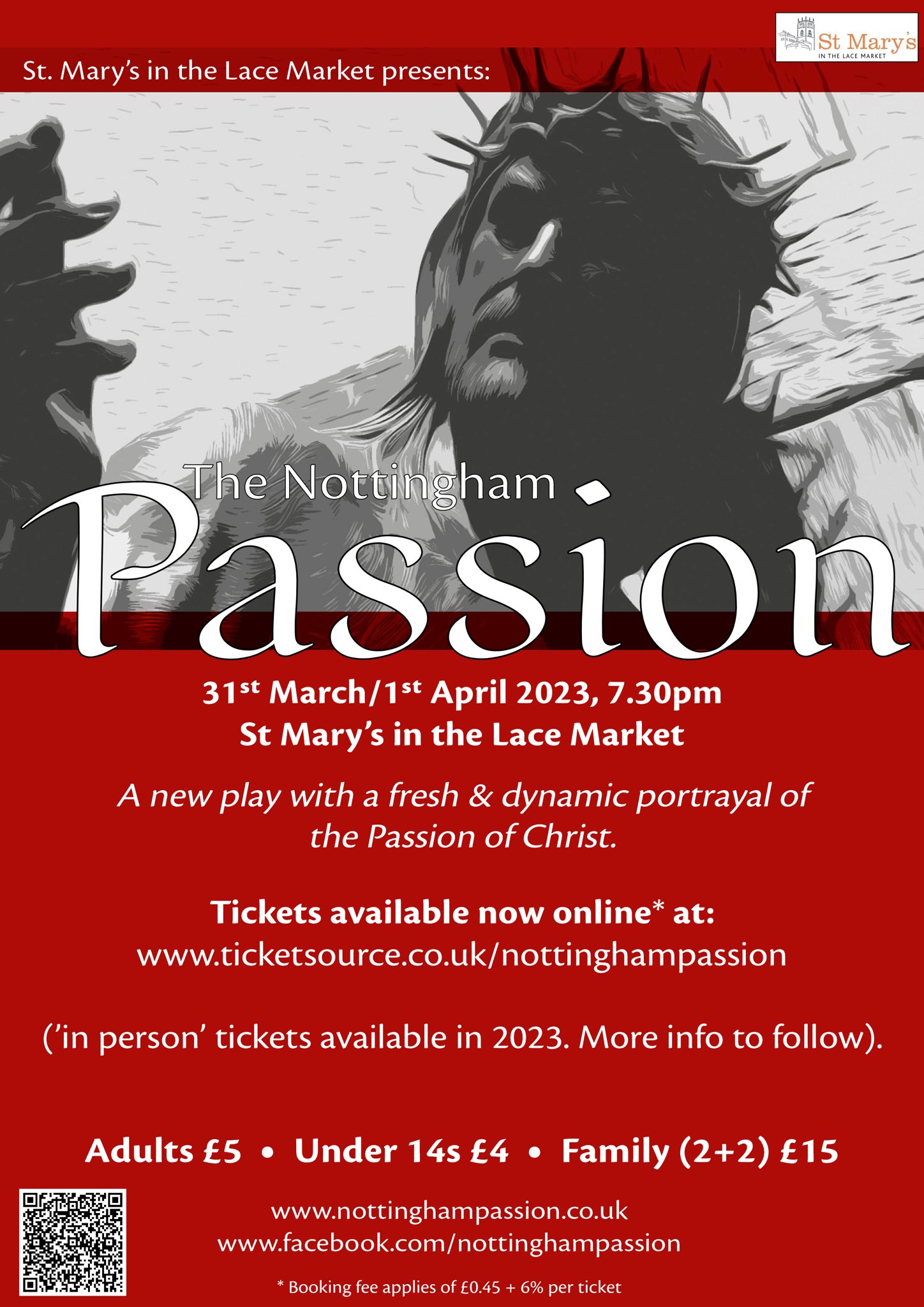
Nottingham Passion poster

So, in preparing to play the character of Jesus, I have to assume that this very same God must be incarnate somewhere in the person of the apoplectic Messiah rebuking those present in Jerusalem’s temple, a man whose followers believe to have been both fully human and fully God. 

Though accounts of miracles are light on the ground during Passion Week, our passion play script shows Jesus healing the Roman guard whose ear is severed in the garden of Gethsemane, and there is (of course) the not insignificant matter of the resurrection. So, it’s clear that Jesus is a man with extraordinary, supernatural power, a man (based on what he says as he’s arrested) secure in the knowledge that God would ‘unleash all his angels’ to defend him if necessary.

And a man with a direct pipeline to such immense power could do something altogether more devastating, altogether more destructive, to those defiling the temple on the Monday of Passion Week, to those turning a house of prayer into a bandit’s cave.

But Jesus doesn’t do this, because he tempers rage with restraint.

Jesus was a human being who knew all about human emotion. He intimately understood human pain and human struggle. In common with Jesus, because we’re also human beings, you and I are capable of rage and restraint. 

A neuroscientist might tell us that when we rage, we’re unlikely to be in control of our actions because the primitive, emotionally driven and impulsive part of our brain has taken charge. There’s even a model which describes this phenomenon in a book called The Chimp Paradox by Steve Peters, which is the last paradox I’ll mention in this blog in case you get annoyed.  

When you and I show restraint, we’re more in control of what we’re doing. When we show restraint we might exercise better self-discipline. We might moderate or restrict our actions. We might even demonstrate compassion, show mercy, or practice forgiveness. None of this is easy, particularly those mercy and forgiveness parts.

Now, imagine such powerful internal conflict, but on a cosmic scale, magnified exponentially in a human being with the might and power of God inside him. What does restraint look like in such a man when he experiences the primitive, impulsive, fully human emotion of rage? The turning over of mere furniture ought to feel like getting off lightly, a miraculous escape, to anyone provoking the wrath of such a man. It could easily have been much, much worse for the merchants and the money changers.

And when the man shouting at you is the most emotionally intelligent, most insightful person to have ever walked the earth, a man who hears people at a different frequency, sees people on a different wavelength, a man who sees the potential for unity and harmony in places where others only see difference and division (see blog one where I unpack all of this), a man who realises that people simply do not know what they’re doing, who sees that people are manifestly incapable of any radical change if left to their own devices, then restraint for that man is absolutely compassion, absolutely mercy, and the pointing of those people to something else.

Something higher, something better. Something much more valuable than material wealth. Something a bit like treasure, hidden in a field.
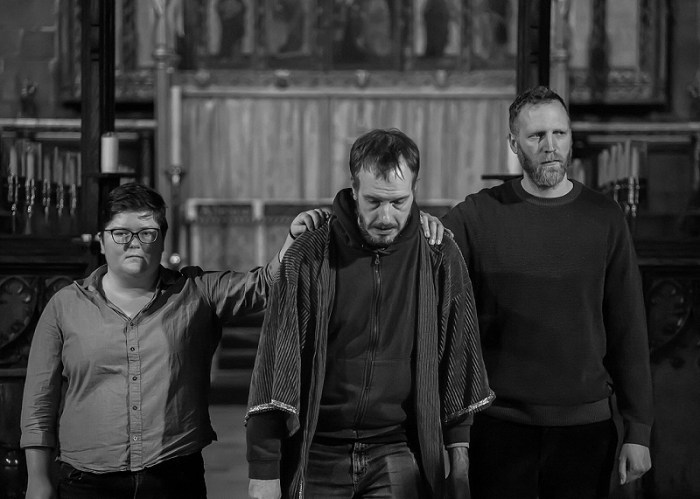
x Notts Passion Rehearsal Pic 13

Jesus knows the people of Jerusalem can’t help themselves. It angers him greatly but he understands how they’ve arrived here. He also knows, as a prophet, how it ends for them (see blog two where I write about this). What Jesus sees in the temple breaks his heart because he knows that people, who are so beloved to him, can be better than this if only they knew, if only they realised. 

Jesus knows the people have become so gaslit, so manipulated, so corrupted by the world in which they live and the powers in charge of that world, that they no longer comprehend what truth is. In speaking truth to power, as Jesus does to those assembled in the temple, he seeks to restore power to truth. As the scene in our show progresses, something destructive gives way, through mercy and compassion, to something constructive. Jesus represents such a radical shift in how God seeks to relate to people.

In trying to consider what the events of Passion Week look like from God’s perspective, I now realise that a huge part of God’s perspective involves explicitly looking at things from our perspective – as a person walking among us.   

Jesus knows the world is broken, that people are broken, and that rage, punishment and retribution offer no route to salvation at all. The cleansing of the temple feels like a major turning point as Old Testament God gives way, through Jesus, to another, better, more relational way of dealing with people. 

While the words aren’t spoken in our production, we know from the Bible that Jesus famously says: ‘Father, forgive them, for they do not know what they are doing,’ even as he hangs on a cross, looking down on the people dividing up his clothes by casting lots. This feels like an extraordinary example of restraint to me, when surely only rage would feel appropriate.

So! All of the above to ponder in getting ready for the cleansing of the temple scene. Maybe I’m just overthinking it, and I need to be careful I don’t go all ‘method’ on you.

Too late! I’ve just thrown a table through a window (*3).

I’ll expand more on other aspects of Jesus’ character as this series develops, and we move onto the next events of Passion Week. Next up, it’s the Last Supper.

Once again, thank you very much for coming with me this far. 

(*1) = I’m not, though.

(*2) = I’m not, though.

(*3) = I didn’t really (*4).

(*4) = It was a chair.

copyright (c) carterbloke, 2023

Links – Nottingham Passion

Passion Statements

Ahead of the production of The Nottingham Passion at St Mary’s in the Lace Market at Easter 2023, we’re creating a series of short promotional videos to tell you about how things are going as we get ready to perform. This post will be updated as new videos are released.

  • Performances take place on Friday 31 March and Saturday 1 April 2023. Buy tickets for the show here.

On the Crucial Matter of Beards [Video #1 – 24/01/23]

Rehearsing the Last Supper [Video #2 – 26/01/23]

Rehearsal Talk [Video #3 – 31/01/23]

Location, Location, Location [Video #4 – 06/02/23]

No Words [Video #5 – 12/02/23]

Equal Ops [Video #6 – 21/02/23]

The Collective Effort [Video #7 – 24/02/23]

Shining Like The Sun [Video #8 – 03/03/23]

Gethsemane [Video #9 – 06/03/23]

My Father’s Scouse [Video #10 – 11/03/23]

Fight! [Video #11 – 12/03/23]

copyright (c) Nottingham Passion, 2023

Links – Nottingham Passion

Talk About The Passion #2 – All Prophets Sometimes

IF YOU’VE READ the first blog in this series, you’ll recall that I’m taking part in The Nottingham Passion theatre production at St Mary’s in the Lace Market this Easter. In the first blog I shared some thoughts about taking on the role of Jesus and how live theatre and storytelling can be so powerful in ministry.

I also shared a bit about how my faith has been (and continues to be) a real struggle and how, as I’ve gone through tough times, there have been long phases where I’ve questioned how there can be a loving God when there is so much suffering in the world. I know I’m not alone in wondering why so many appalling things seem to happen to so many non-appalling people while real evil appears to flourish and prosper.

Notts Passion Rehearsal Pic 1 800x504

I explained that my perspective has often been that of a frustrated human being remonstrating with God about how he could surely make all the bad things go away if he really wanted to. I explained how taking on the role of Jesus has pushed me to try to look more carefully at what God’s perspective on these matters might be.

I also suggested that, whether a person has a faith or no faith at all, there is at least broad common ground to be occupied when considering the figure of Jesus. Whether you believe Jesus to be the son of God, or instead to have been a mere human being who had some interesting things to say about love and morality, he surely must, as a minimum, have been a wholly decent man with decent intentions. Historical accounts appear to show that Jesus knowingly took actions which led to his public humiliation and execution, all with the apparent motivation of wanting to save human lives, human souls, and make all things well in the end. So, whatever your feelings are about this man, more likely than not you’d want him on your side if the chips were down.

Before I continue, I promise there are no theological or philosophical bear traps lying in wait for you as you read. In fact, here are some rules of engagement for this blog and the others which follow:

rule-1752536_1280

  1. I’m not going to try to answer all (any?) of life’s big questions for you, though I hope there may be something in what I’m writing which prompts you to explore some of these questions more deeply;
  2. I’m not going to preach to you – I have a faith, but this stuff is aimed at everyone, whatever their point of view;
  3. There is no pre-planned structure to this series which ends with me ‘seeing the light’ through my experience of playing Jesus. There’ll be no fluffy, gift-wrapped testimony from me at the end. That would be so twee, and perhaps a little cynical. So, to be clear. I genuinely don’t know how these pieces of writing will develop;
  4. I’m not about to get all ‘pretentious artist’ on you. I’m not that person, and I don’t do this acting lark for a living. I’m a part-time writer and performer who sincerely just wants to do the best job he can, as honestly as he can.

So, with all that said, some other helpful basics. It strikes me that I’ve not yet explained to you what passion plays are.

Online resources such as those provided by The Passion Trust will give you the detail, but in brief, passion plays are dramatic presentations of the parts of the Bible that tell of Jesus’ final days of suffering and death. Performing these events in the run up to Easter is a long-established tradition across the UK and Europe.

For this instalment, we’ll look at the first big event – Palm Sunday and the triumphal entry into Jerusalem – and what this experience may have been like from the perspective of the central figure in all of it.

Disclaimer: remember rule number 4 about not getting ‘all pretentious’? That’s still true, but any theatre geek mafia reading this might accuse me of straying into ‘substitution’ territory (if you really want to know what I’m on about here, google the words ‘Uta Hagen method’).

Put simply (and obviously), in preparing to portray Jesus as authentically as possible, I have no comparable lived experience of being fully God and fully human to draw upon, in the same way that I had no comparable lived experience of hanging out at the top of a beanstalk with a golden egg-laying chicken to draw upon the last time I did village panto. Both acting roles present giant challenges. This is an objectively excellent joke intended to:

  • avoid accusations of being just some bonkers old luvvie and
  • completely annoy the theatre geek mafia.

I wasn’t the world’s most attentive drama degree student, and I found a lot of actor theory quite tedious. There, I’ve said it.

But any truthful storyteller needs to find some points of authentic engagement and connection with the character whose story they’re telling, otherwise the character’s words are just words on a page, or words in an ancient book somewhere, meaningless in a modern world. So I need to try to feel this stuff somehow, which is hard work.

I don’t think that what Jesus said is meaningless in a modern world, but I accept that others do, and that others are just indifferent. Come see the show anyway. See how the story feels to you when it’s lifted off the page.

Nottingham Passion poster

Point is, as I’ve read into what Jesus did and went through during the events of Passion Week (and tried to work out how to bring over a sense of this in performance) several aspects of the story have really resonated with me, with some packing real emotional punch.

It doesn’t make its way into our script, but there’s the not insignificant matter of Jesus weeping over Jerusalem on Palm Sunday. Oh, and predicting the future. The weeping is there in the gospel accounts of Matthew and Luke just prior to Jesus’ triumphal entry into Jerusalem, and it’s helped me to better understand something about the mixed (and quite possibly far from triumphant) human feelings Jesus is experiencing. It clearly isn’t all hurrahs and hosannas. There’s something more nuanced and bittersweet taking place.

‘If you had only known on this day what would bring you peace – but now it is hidden from your eyes,’ Jesus says, before crying his own eyes out.

‘The days will come upon you when your enemies will build an embankment against you and encircle you and hem you in on every side. They will dash you to the ground, you and the children within your walls.’

I think they must have skipped this bit when they taught me about Easter at primary school, cunningly replacing it with chocolate and bunnies.

Biblical scholars believe that Jesus is predicting the Great Siege of Jerusalem here, in which the Roman army captured Jerusalem and destroyed both the city and its temple. History records the siege as taking place in AD 70, some 40 years after Jesus weeps over the city. Whether we accept Jesus’ words as prophecy or simply reject them out of hand, from a storytelling perspective the key trigger for our central character’s extraordinary outburst appears to be found in the words:

‘You (Jerusalem) did not recognise the time of God’s coming to you.’

Jesus weeps primarily because the people don’t know him … at all. They don’t recognise him for who and what he is … at all. They fatally misunderstand him, and this comes with consequences. There’s nothing Jesus can do to avert what is coming, and it’s breaking his heart.

Jesus weeps at the coming destruction these people will face. On Palm Sunday, he knows that he’s riding into Jerusalem towards certain death, and that there are people singing hosanna who, in a matter of days, will join the mob screaming for his execution. Before he even gets to Jerusalem in the bible, Jesus has already predicted his death on at least three occasions.

Palm Sunday is a breathtaking, bittersweet balance of sorrow and joy.

Who’d be a prophet, heh?

Notts Passion Rehearsal Pic 3 800x475

Thing is, I have a theory that we’re all prophets sometimes. Seeing the future can be a really tough gig.

For some of us, seeing the future may come in the certainty we have that the dearest one in our lives, for whom we would do anything and everything, will go through such anguish as they fight a serious illness, fight with all their strength to remain with us, for we are their dearest one also.

It may come in the certainty we have that another dear one needs us to be their foundation and strength through something we simply cannot repair for them, whether that be another long-term or permanent illness, or a failing relationship which is now in free fall, hurtling downward onto jagged rocks.

For some of us, seeing the future may come in the certainty we have that our young ones, at some point, are going to make some decisions which will unravel and end badly, but that we must give them the freedom to make those decisions for themselves as we were given that same freedom once. If they’re ever to learn strength and resilience, we need to let them go, let them try, come what may. We know they cannot run until they can walk, cannot fly until they can run, and we dearly want them to fly. But until they discover what true hurt and disappointment feel like, and come to understand each of these in their own way, on their own terms, this just isn’t possible.

Oh! The frustration we have that we can’t just fix things for the people we love, that we can’t just make the pain go away, that there isn’t more we can do. If only. If only.

If only we could try to take their place.

Of course you and I can see the future, albeit within our strict human limitations. We’re all prophets, to a degree. Each one of us. And we walk among prophets, every day.

Sheesh. Fair takes it out of you, this substitution business.

Notts Passion Rehearsal Pic 2 800x600

To finish, some insight from the first week of rehearsals. We’re not rehearsing in the main church yet, but in one of the adjoining rooms. There are various photos from the rehearsals above – that’s me cross-legged on the floor in the top photo, which I’m calling ‘parable on the parquet.’

Before we get to Palm Sunday in the show, there’s a prelude where Jesus is introduced and the disciples are first called, then we fast forward three years to triumphal entry.

Director James Pacey is keen that the dialogue isn’t rushed, and that every time Jesus meets someone for the first time (new disciple or otherwise) there is a fresh joy, a fresh delight, in him at that encounter. It’s a powerful concept to consider that, even in a multitude, Jesus can pick someone out and speak with them like they’re the only person in the room. It’s like there are no anonymous faces in the crowd with him. Also, to meet a person for the first time and see them, know them, instantly. To see the light in every soul, and want to join with it.

If Jesus has a superpower on Palm Sunday, it’s that he can see true colours. It’s a superpower he may share with Cyndi Lauper.

And what a blessing, or maybe a curse, to be able to see the beauty, utterly untarnished, in everything and everyone. To see the absolute capacity for beauty, and love, and joy, in every human being. To see the glorious, magnificent colours pouring out of everyone and everything, despite the grime, the hurt, the darkness. To see the colours in humanity that humanity can’t see itself, to see the awesome possibility in every single one of them, but to know how it all ends for them anyway. The heartbreak, the agony, of knowing that the beloved, the treasured, the cherished, just can’t comprehend how very beautiful they are, may never come to comprehend it.

Just his words on their own. Take out the theology, the doctrine, the dogma, the rules, the ignorance, the in-fighting. Strip it all back. It really isn’t Jesus who’s the problem. It’s people, and institutions, it’s us. It’s what we’ve made of him.

At they’re purest, at they’re rawest, his are some of the most emotionally intelligent, superhumanly insightful words ever uttered. Reading about him, it’s like he heard people at a different frequency, saw people on a different wavelength. We see difference, and division. He sees unity, and harmony. He sees all the colours of the spectrum in super high definition. We can’t see the spectrum for looking at the grey clouds obscuring our view and, sadly, some of us seem to be content with those grey clouds being there, unwilling to look underneath, for fear of what we may find, for fear of having to make a change.

I love this quote in the Thomas Merton book Conjectures of a Guilty Bystander, (and this fella must know what he’s talking about on this subject because he’s a Trappist monk). Thomas Merton had this to say about the people he saw walking past him on a busy street corner:

  • ‘In Louisville, at the corner of Fourth and Walnut, in the centre of the shopping district, I was suddenly overwhelmed with the realisation that I loved all these people, that they were mine and I theirs, that we could not be alien to one another even though we were total strangers. … I have the immense joy of being man, a member of a race in which God himself became incarnate. As if the sorrows and stupidities of the human condition could overwhelm me, now that I realise what we all are. … If only we could see each other that way all the time. There would be no more hatred, no more greed. … There is no way of telling people that they are all walking around shining like the sun.’

I like to think there’s something of Thomas Merton in all of us, and perhaps something of Jesus in us too, because this is how I think Jesus must have seen people.

So, anyway – all those things you’ve just read, but bringing those to bear on playing Jesus. If only I’d had this approach to Jack and Beanstalk, I could have turned panto into a serious art form.

Oh no, I couldn’t!

Once again, thanks so much for staying with me this far. More to follow.

Next time. Jesus gets angry. Grr.

copyright (c) carterbloke, 2023

Links – Nottingham Passion

Talk About The Passion #1 – Perfect Words and Perfect Actions

carterblokeMY NAME IS SIMON, and I’m a writer.

Mostly, I write plays. I’m not a famous writer – it’s unlikely you’ve heard much about me or seen anything I’ve written. This doesn’t mean I’m a rubbish writer. I scrub up well. I’ve had some quite lovely reviews and everything, but never had that ‘big opportunity.’

I’m peaceful about it because I’ve only ever written for the joy of creating things that might be funny, thought-provoking, or maybe even (gasp!) meaningful for some people, and to make an audience feel differently about something really important when they’ve finished watching.

I set myself high standards and take my writing seriously in case Spielberg turns up. I’ve written thousands of lines of dialogue, and I’ve wanted these to be impactful on audiences, so I’ve spent a long time trying to construct perfect combinations of words. ‘High standards’ in these terms, of course, means ‘impossible standards.’ Nobody’s perfect, right?

I’ve found, in all my years of effort, that there is no such thing as a perfect combination of words, certainly nothing that any one person could commit to paper that was so extraordinary, so powerful, it would not only resonate with all people, everywhere, at all times, for all time, but actually change the world. Not just theoretically. Actually. Actually change how people think, change how people behave and treat each other, for the betterment of everyone, for the benefit of everyone, forever.

There are no perfect combinations of words in plays and stories even if you’re Shakespeare (I’m sorry, English teachers everywhere). And there are no perfect combinations of words in life – in common use, out there in the world, every day. 

I wish there were perfect combinations of words, because they would solve so many problems.

  • With one perfect combination of words you could give such overwhelming encouragement to someone consumed by personal struggle that they wouldn’t be struggling anymore once you’d said those words, because struggle would be over.
  • With a second perfect combination of words you could heal a heart that was breaking, make someone’s despair utterly disappear, because your words will have defeated despair.
  • With a third perfect combination of words you could stop someone from having to cope with the agony of loss or grief, because loss and grief would be banished at once with the passing of those perfect words from your lips.

Also, can you imagine a perfect combination of words alongside a perfect combination of actions?

  • With one perfect combination of words and actions you could cure cancer, end poverty, restore and reset a broken world.
  • With another perfect combination of words and actions you could make the blind see, the lame walk, the dead come back to life.
  • With a third perfect combination of words and actions you could instantly convince everyone there was a loving God and transform their lives forever. 

But on the third of these, I guess, I’d first have to find that perfect combination of words and actions for myself, because I’ve had so much doubt about spiritual things.

Please don’t run away screaming if you think I’m going ‘all religious’ on you. I’m not about to start preaching. I would have lured you here under false pretences if I did. That would be dishonest, and I promise I’m going to be completely honest with you.

Passion Play 1aTruth is, I’ve often felt there can be no God at all, certainly not a trustworthy or loving one, when there is so much wretchedness and suffering everywhere. Presumably God would have the power to do something about all of that if he was really there and he really wanted to. He could just take all the bad stuff away entirely, right? I mean today. Right now.

I’ve accepted that it can never be that simple.

In faith terms, I have been all at sea for a long time. I’ve found no perfect words to help me with the doubt, disappointment and, very often, utter fury I’ve felt about God, about church, about religion. I didn’t become all happy clappy when I was baptised ten years ago. Quite the reverse. Many truly horrible things happened to me (and to people whom I love more than life itself) in the years afterwards and these things made me, at least for a time, decidedly unhappy crappy. I didn’t run away from my faith, or completely depart from church when these things happened, but in fairness I only hung on by the slenderest of threads.

I’ve kept searching throughout it all and (you may be relieved to hear) have had some joyful times along the way. I’ve read lots of stuff on the subject of faith because I’m interested, and I want to know more. Greater theological minds than mine have attempted to explain away the problem of pain down the ages and why it’s all supposedly part of some ‘greater plan.’

So many minds. 

So …. many … books. 

Passion Play 2aBe careful. The books can do your head in. I flung a hefty C.S. Lewis across the room last week. Not the author C.S. Lewis, who’s been dead since 1963. I didn’t fling C.S. Lewis across a room. It was one of his books on Christianity which was frustrating me. Don’t get me wrong. I love Narnia and Aslan (spoiler: Aslan is Jesus), but I’m not sure about some of the author’s thoughts on some aspects of the Christian faith.
Mention of God’s so-called ‘greater plan,’ a ‘greater plan’ that you and I can never fully comprehend, certainly not in this life, has challenged me so much in moments of grief and tragedy, I  have struggled to accept the idea. How does this ‘greater plan,’ how can this ‘greater plan’ possibly be served by the trauma and devastation of suddenly losing a loved one? How can it possibly be served by a terrifying cancer diagnosis in the love of your life? How could any ‘greater plan’ possibly and reasonably permit the seemingly inexplicable suffering of innocents alongside the rise and prospering of real evil in this world?

Maybe the answer is that there is no God at all. But at the core of me, I know this doesn’t feel true. 

It may feel true for you if you have no belief in God at all, or in any God at all, or you’re just undecided, or you don’t much care because you’re making a Pot Noodle right now.

I’m not saying I’m right about life’s big questions, and you’re wrong. None of us can know for certain, no matter how passionately we articulate our position. The one thing I’m reasonably sure about, though, is that we’ll all find out one way or the other at some point, by which time it will be far too late for ‘told you so’s.’

Passion Play 3aBut for the avoidance of doubt, you should know that I have a faith. I’ve realised that I’ve mostly considered faith matters through the prism of the impact these have on people and the practical, worldly issues we have to deal with. I’m all over the people perspective. Other human beings, and me.
Me, me, me.

Grr.

Given what I’ve been through, and the pain I’ve known and felt, my perspective has often been that of a frustrated, despairing human being, raising a fist to the sky and remonstrating to God about how bad everything is and how rubbish he must be at being God if he just lets it all happen, and maybe he could just show up and explain it all to me, please, because I’d really like to know.

Oh! The injustices of this world! Why, exactly? 

I’ve realised more recently that I’ve never properly considered what God’s perspective must be on all of these things. His view of the world hasn’t really preoccupied me much before now, mainly because I’ve been shouting at him far too much about my own perspective.

Thing is, something’s just happened to me. Something that feels really important to me – and it seems I now have no choice but to try to look at the world from God’s perspective, and try to bring across something of what that perspective might be to audiences.

Because, in a few months’ time, I’m going to play the part of Jesus Christ in a theatre production in Nottingham. It’s called The Nottingham Passion at it’s on at St Mary’s in the Lace Market.

Nottingham Passion poster

I’m also a performer, you see.

I’m not a famous performer – it’s unlikely you’ve heard much about me or seen anything I’ve been in. This doesn’t mean I’m a rubbish performer. I scrub up well, and other recycled prose from paragraph two of this blog. 

There was an audition I went to back in November last year, one which I very nearly got cold feet about because my self-confidence had taken a real bashing. I went to the audition because I wanted to find a way back into some kind of faith life, find a way back into a church building somehow, and find a way of doing some good with this ‘gift’ of communicating that people keep telling me I have. 

I didn’t know what I was expecting.  I hadn’t done any kind of audition in years. Pontius Pilate, maybe, because I have a Roman nose.

Passion Play 4aBut reading for the part of Jesus and then being cast as him? I guess if there was a shortlist of people in human history who you’d think had come closest to speaking perfect words and taking perfect actions, Jesus would likely be on that list somewhere.
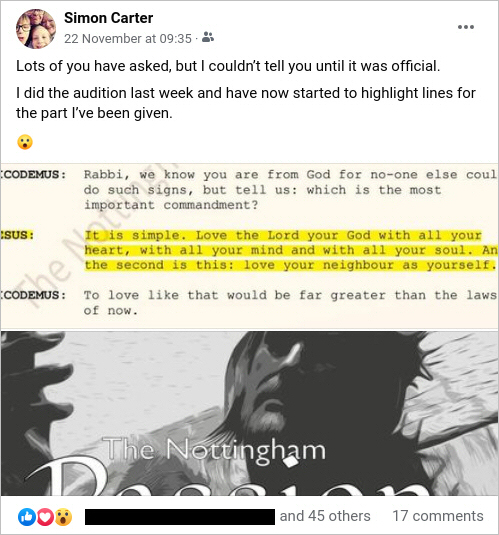
So here I am, staring down the barrel of playing the part of Jesus. I want to do the very best job I can. There’s no way I’m taking this lightly, because doing this is among the privileges of my life. So, I’ll prepare properly and thoroughly, and I’ll try to see and show the events of Passion Week from Jesus’ perspective. It’s a great script, with a great director in the Reverend James Pacey, and many strong voices across the whole cast. Plus it’s live theatre and storytelling, which can be so very powerful in ministry. Here’s what James has to say about the subject.

So, as I consider the various ramifications of that monumental, world-changing few days in Jerusalem two millennia ago, I’ll aim to share some thoughts about how the events of Passion Week might have felt whilst being stood in the shoes (sandals?) of the central figure in all of it.

Jesus is a complex and divisive figure. There’s no real dispute about this, and we sugar-coat him at our peril. I don’t think this production will be pulling any punches.

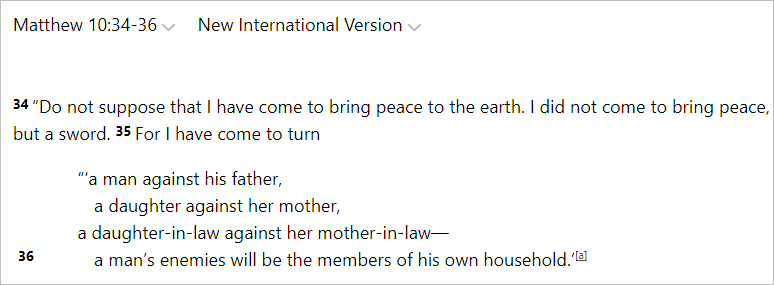
Matthew 10

Jesus was divisive then, he’s divisive now. Whether you consider Jesus, as Christians do, to be the son of God, both fully human and fully God, or you consider him instead to have been merely a human being who offered some sound moral teaching we can choose to accept, reject or simply ignore, the common ground surely is that Jesus must have been, at the very least, a good and decent man with the very best of intentions. You’d want him on your side, for sure. You’d want him to have your back.

Maybe we could even agree that Jesus was a great man, with hugely important things to say about the human condition, about human struggle, about life, about relationships, about love, about hope, about morality.

Maybe we could agree that he was an immensely courageous and determined man who took unimaginable personal risks to say what he felt needed saying to bring about the possibility of radical change in people and hope for the last, the least and the lost. The truth bombs Jesus dropped about institutional corruption, hypocrisy, and abuse of position and privilege, made him powerful enemies in the religious and political authorities of his day. It was these people who became so hell bent on silencing Jesus and destroying him.  

Jesus was great enough and impactful enough that people are still talking about him some two thousand years later, and whether or not you believe that Jesus was the son of God, history nonetheless appears to record that this man took a series of planned and deliberate actions, over a period of around three years, which he knew would lead to his public humiliation and execution, all with the apparent endgame of saving human lives, human souls, and making all things well, in the end. 

Passion Play 5aLike it or not, welcome it or not, the fella appears to have chosen to die for the human race and, last I heard, that includes you and me. Doubt his authenticity, doubt what motivated him, doubt his state of mind if you like, completely turn your back on the whole concept of it if that’s your choice, but Jesus’ very specific decision appears to have been to die for everyone, whether we wanted him to or not. 

What we make of all of this is up to us. I can’t make you pick up a Bible if you don’t want to. Sometimes I struggle to pick up a Bible myself. That choice is yours, and that choice is mine. But for me, what’s got me searching again, what’s got me passionate again, is the chance to explore this story in a way I’ve never explored it before, learn a bit more about Jesus myself, and show something of who he was and is to anyone who wants to come along and see the show. The tickets are on sale now, and you can get them here.

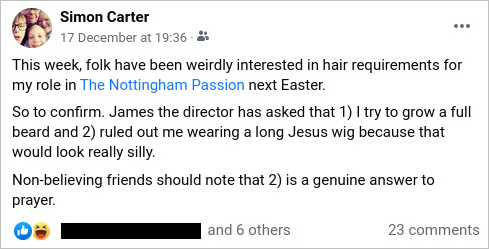
So, this initial salvo will turn into a series of articles as thoughts and insights occur, and as the rehearsal process develops in earnest. Just so you know, beard growth has been insisted upon.

Thanks so much for staying with me this far already. 

copyright (c) carterbloke, 2023

Links – Nottingham Passion