Talk About The Passion #2 – All Prophets Sometimes

IF YOU’VE READ the first blog in this series, you’ll recall that I’m taking part in The Nottingham Passion theatre production at St Mary’s in the Lace Market this Easter. In the first blog I shared some thoughts about taking on the role of Jesus and how live theatre and storytelling can be so powerful in ministry.

I also shared a bit about how my faith has been (and continues to be) a real struggle and how, as I’ve gone through tough times, there have been long phases where I’ve questioned how there can be a loving God when there is so much suffering in the world. I know I’m not alone in wondering why so many appalling things seem to happen to so many non-appalling people while real evil appears to flourish and prosper.

Notts Passion Rehearsal Pic 1 800x504

I explained that my perspective has often been that of a frustrated human being remonstrating with God about how he could surely make all the bad things go away if he really wanted to. I explained how taking on the role of Jesus has pushed me to try to look more carefully at what God’s perspective on these matters might be.

I also suggested that, whether a person has a faith or no faith at all, there is at least broad common ground to be occupied when considering the figure of Jesus. Whether you believe Jesus to be the son of God, or instead to have been a mere human being who had some interesting things to say about love and morality, he surely must, as a minimum, have been a wholly decent man with decent intentions. Historical accounts appear to show that Jesus knowingly took actions which led to his public humiliation and execution, all with the apparent motivation of wanting to save human lives, human souls, and make all things well in the end. So, whatever your feelings are about this man, more likely than not you’d want him on your side if the chips were down.

Before I continue, I promise there are no theological or philosophical bear traps lying in wait for you as you read. In fact, here are some rules of engagement for this blog and the others which follow:

rule-1752536_1280

  1. I’m not going to try to answer all (any?) of life’s big questions for you, though I hope there may be something in what I’m writing which prompts you to explore some of these questions more deeply;
  2. I’m not going to preach to you – I have a faith, but this stuff is aimed at everyone, whatever their point of view;
  3. There is no pre-planned structure to this series which ends with me ‘seeing the light’ through my experience of playing Jesus. There’ll be no fluffy, gift-wrapped testimony from me at the end. That would be so twee, and perhaps a little cynical. So, to be clear. I genuinely don’t know how these pieces of writing will develop;
  4. I’m not about to get all ‘pretentious artist’ on you. I’m not that person, and I don’t do this acting lark for a living. I’m a part-time writer and performer who sincerely just wants to do the best job he can, as honestly as he can.

So, with all that said, some other helpful basics. It strikes me that I’ve not yet explained to you what passion plays are.

Online resources such as those provided by The Passion Trust will give you the detail, but in brief, passion plays are dramatic presentations of the parts of the Bible that tell of Jesus’ final days of suffering and death. Performing these events in the run up to Easter is a long-established tradition across the UK and Europe.

For this instalment, we’ll look at the first big event – Palm Sunday and the triumphal entry into Jerusalem – and what this experience may have been like from the perspective of the central figure in all of it.

Disclaimer: remember rule number 4 about not getting ‘all pretentious’? That’s still true, but any theatre geek mafia reading this might accuse me of straying into ‘substitution’ territory (if you really want to know what I’m on about here, google the words ‘Uta Hagen method’).

Put simply (and obviously), in preparing to portray Jesus as authentically as possible, I have no comparable lived experience of being fully God and fully human to draw upon, in the same way that I had no comparable lived experience of hanging out at the top of a beanstalk with a golden egg-laying chicken to draw upon the last time I did village panto. Both acting roles present giant challenges. This is an objectively excellent joke intended to:

  • avoid accusations of being just some bonkers old luvvie and
  • completely annoy the theatre geek mafia.

I wasn’t the world’s most attentive drama degree student, and I found a lot of actor theory quite tedious. There, I’ve said it.

But any truthful storyteller needs to find some points of authentic engagement and connection with the character whose story they’re telling, otherwise the character’s words are just words on a page, or words in an ancient book somewhere, meaningless in a modern world. So I need to try to feel this stuff somehow, which is hard work.

I don’t think that what Jesus said is meaningless in a modern world, but I accept that others do, and that others are just indifferent. Come see the show anyway. See how the story feels to you when it’s lifted off the page.

Nottingham Passion poster

Point is, as I’ve read into what Jesus did and went through during the events of Passion Week (and tried to work out how to bring over a sense of this in performance) several aspects of the story have really resonated with me, with some packing real emotional punch.

It doesn’t make its way into our script, but there’s the not insignificant matter of Jesus weeping over Jerusalem on Palm Sunday. Oh, and predicting the future. The weeping is there in the gospel accounts of Matthew and Luke just prior to Jesus’ triumphal entry into Jerusalem, and it’s helped me to better understand something about the mixed (and quite possibly far from triumphant) human feelings Jesus is experiencing. It clearly isn’t all hurrahs and hosannas. There’s something more nuanced and bittersweet taking place.

‘If you had only known on this day what would bring you peace – but now it is hidden from your eyes,’ Jesus says, before crying his own eyes out.

‘The days will come upon you when your enemies will build an embankment against you and encircle you and hem you in on every side. They will dash you to the ground, you and the children within your walls.’

I think they must have skipped this bit when they taught me about Easter at primary school, cunningly replacing it with chocolate and bunnies.

Biblical scholars believe that Jesus is predicting the Great Siege of Jerusalem here, in which the Roman army captured Jerusalem and destroyed both the city and its temple. History records the siege as taking place in AD 70, some 40 years after Jesus weeps over the city. Whether we accept Jesus’ words as prophecy or simply reject them out of hand, from a storytelling perspective the key trigger for our central character’s extraordinary outburst appears to be found in the words:

‘You (Jerusalem) did not recognise the time of God’s coming to you.’

Jesus weeps primarily because the people don’t know him … at all. They don’t recognise him for who and what he is … at all. They fatally misunderstand him, and this comes with consequences. There’s nothing Jesus can do to avert what is coming, and it’s breaking his heart.

Jesus weeps at the coming destruction these people will face. On Palm Sunday, he knows that he’s riding into Jerusalem towards certain death, and that there are people singing hosanna who, in a matter of days, will join the mob screaming for his execution. Before he even gets to Jerusalem in the bible, Jesus has already predicted his death on at least three occasions.

Palm Sunday is a breathtaking, bittersweet balance of sorrow and joy.

Who’d be a prophet, heh?

Notts Passion Rehearsal Pic 3 800x475

Thing is, I have a theory that we’re all prophets sometimes. Seeing the future can be a really tough gig.

For some of us, seeing the future may come in the certainty we have that the dearest one in our lives, for whom we would do anything and everything, will go through such anguish as they fight a serious illness, fight with all their strength to remain with us, for we are their dearest one also.

It may come in the certainty we have that another dear one needs us to be their foundation and strength through something we simply cannot repair for them, whether that be another long-term or permanent illness, or a failing relationship which is now in free fall, hurtling downward onto jagged rocks.

For some of us, seeing the future may come in the certainty we have that our young ones, at some point, are going to make some decisions which will unravel and end badly, but that we must give them the freedom to make those decisions for themselves as we were given that same freedom once. If they’re ever to learn strength and resilience, we need to let them go, let them try, come what may. We know they cannot run until they can walk, cannot fly until they can run, and we dearly want them to fly. But until they discover what true hurt and disappointment feel like, and come to understand each of these in their own way, on their own terms, this just isn’t possible.

Oh! The frustration we have that we can’t just fix things for the people we love, that we can’t just make the pain go away, that there isn’t more we can do. If only. If only.

If only we could try to take their place.

Of course you and I can see the future, albeit within our strict human limitations. We’re all prophets, to a degree. Each one of us. And we walk among prophets, every day.

Sheesh. Fair takes it out of you, this substitution business.

Notts Passion Rehearsal Pic 2 800x600

To finish, some insight from the first week of rehearsals. We’re not rehearsing in the main church yet, but in one of the adjoining rooms. There are various photos from the rehearsals above – that’s me cross-legged on the floor in the top photo, which I’m calling ‘parable on the parquet.’

Before we get to Palm Sunday in the show, there’s a prelude where Jesus is introduced and the disciples are first called, then we fast forward three years to triumphal entry.

Director James Pacey is keen that the dialogue isn’t rushed, and that every time Jesus meets someone for the first time (new disciple or otherwise) there is a fresh joy, a fresh delight, in him at that encounter. It’s a powerful concept to consider that, even in a multitude, Jesus can pick someone out and speak with them like they’re the only person in the room. It’s like there are no anonymous faces in the crowd with him. Also, to meet a person for the first time and see them, know them, instantly. To see the light in every soul, and want to join with it.

If Jesus has a superpower on Palm Sunday, it’s that he can see true colours. It’s a superpower he may share with Cyndi Lauper.

And what a blessing, or maybe a curse, to be able to see the beauty, utterly untarnished, in everything and everyone. To see the absolute capacity for beauty, and love, and joy, in every human being. To see the glorious, magnificent colours pouring out of everyone and everything, despite the grime, the hurt, the darkness. To see the colours in humanity that humanity can’t see itself, to see the awesome possibility in every single one of them, but to know how it all ends for them anyway. The heartbreak, the agony, of knowing that the beloved, the treasured, the cherished, just can’t comprehend how very beautiful they are, may never come to comprehend it.

Just his words on their own. Take out the theology, the doctrine, the dogma, the rules, the ignorance, the in-fighting. Strip it all back. It really isn’t Jesus who’s the problem. It’s people, and institutions, it’s us. It’s what we’ve made of him.

At they’re purest, at they’re rawest, his are some of the most emotionally intelligent, superhumanly insightful words ever uttered. Reading about him, it’s like he heard people at a different frequency, saw people on a different wavelength. We see difference, and division. He sees unity, and harmony. He sees all the colours of the spectrum in super high definition. We can’t see the spectrum for looking at the grey clouds obscuring our view and, sadly, some of us seem to be content with those grey clouds being there, unwilling to look underneath, for fear of what we may find, for fear of having to make a change.

I love this quote in the Thomas Merton book Conjectures of a Guilty Bystander, (and this fella must know what he’s talking about on this subject because he’s a Trappist monk). Thomas Merton had this to say about the people he saw walking past him on a busy street corner:

  • ‘In Louisville, at the corner of Fourth and Walnut, in the centre of the shopping district, I was suddenly overwhelmed with the realisation that I loved all these people, that they were mine and I theirs, that we could not be alien to one another even though we were total strangers. … I have the immense joy of being man, a member of a race in which God himself became incarnate. As if the sorrows and stupidities of the human condition could overwhelm me, now that I realise what we all are. … If only we could see each other that way all the time. There would be no more hatred, no more greed. … There is no way of telling people that they are all walking around shining like the sun.’

I like to think there’s something of Thomas Merton in all of us, and perhaps something of Jesus in us too, because this is how I think Jesus must have seen people.

So, anyway – all those things you’ve just read, but bringing those to bear on playing Jesus. If only I’d had this approach to Jack and Beanstalk, I could have turned panto into a serious art form.

Oh no, I couldn’t!

Once again, thanks so much for staying with me this far. More to follow.

Next time. Jesus gets angry. Grr.

copyright (c) carterbloke, 2023

Links – Nottingham Passion

Talk About The Passion #1 – Perfect Words and Perfect Actions

carterblokeMY NAME IS SIMON, and I’m a writer.

Mostly, I write plays. I’m not a famous writer – it’s unlikely you’ve heard much about me or seen anything I’ve written. This doesn’t mean I’m a rubbish writer. I scrub up well. I’ve had some quite lovely reviews and everything, but never had that ‘big opportunity.’

I’m peaceful about it because I’ve only ever written for the joy of creating things that might be funny, thought-provoking, or maybe even (gasp!) meaningful for some people, and to make an audience feel differently about something really important when they’ve finished watching.

I set myself high standards and take my writing seriously in case Spielberg turns up. I’ve written thousands of lines of dialogue, and I’ve wanted these to be impactful on audiences, so I’ve spent a long time trying to construct perfect combinations of words. ‘High standards’ in these terms, of course, means ‘impossible standards.’ Nobody’s perfect, right?

I’ve found, in all my years of effort, that there is no such thing as a perfect combination of words, certainly nothing that any one person could commit to paper that was so extraordinary, so powerful, it would not only resonate with all people, everywhere, at all times, for all time, but actually change the world. Not just theoretically. Actually. Actually change how people think, change how people behave and treat each other, for the betterment of everyone, for the benefit of everyone, forever.

There are no perfect combinations of words in plays and stories even if you’re Shakespeare (I’m sorry, English teachers everywhere). And there are no perfect combinations of words in life – in common use, out there in the world, every day. 

I wish there were perfect combinations of words, because they would solve so many problems.

  • With one perfect combination of words you could give such overwhelming encouragement to someone consumed by personal struggle that they wouldn’t be struggling anymore once you’d said those words, because struggle would be over.
  • With a second perfect combination of words you could heal a heart that was breaking, make someone’s despair utterly disappear, because your words will have defeated despair.
  • With a third perfect combination of words you could stop someone from having to cope with the agony of loss or grief, because loss and grief would be banished at once with the passing of those perfect words from your lips.

Also, can you imagine a perfect combination of words alongside a perfect combination of actions?

  • With one perfect combination of words and actions you could cure cancer, end poverty, restore and reset a broken world.
  • With another perfect combination of words and actions you could make the blind see, the lame walk, the dead come back to life.
  • With a third perfect combination of words and actions you could instantly convince everyone there was a loving God and transform their lives forever. 

But on the third of these, I guess, I’d first have to find that perfect combination of words and actions for myself, because I’ve had so much doubt about spiritual things.

Please don’t run away screaming if you think I’m going ‘all religious’ on you. I’m not about to start preaching. I would have lured you here under false pretences if I did. That would be dishonest, and I promise I’m going to be completely honest with you.

Passion Play 1aTruth is, I’ve often felt there can be no God at all, certainly not a trustworthy or loving one, when there is so much wretchedness and suffering everywhere. Presumably God would have the power to do something about all of that if he was really there and he really wanted to. He could just take all the bad stuff away entirely, right? I mean today. Right now.

I’ve accepted that it can never be that simple.

In faith terms, I have been all at sea for a long time. I’ve found no perfect words to help me with the doubt, disappointment and, very often, utter fury I’ve felt about God, about church, about religion. I didn’t become all happy clappy when I was baptised ten years ago. Quite the reverse. Many truly horrible things happened to me (and to people whom I love more than life itself) in the years afterwards and these things made me, at least for a time, decidedly unhappy crappy. I didn’t run away from my faith, or completely depart from church when these things happened, but in fairness I only hung on by the slenderest of threads.

I’ve kept searching throughout it all and (you may be relieved to hear) have had some joyful times along the way. I’ve read lots of stuff on the subject of faith because I’m interested, and I want to know more. Greater theological minds than mine have attempted to explain away the problem of pain down the ages and why it’s all supposedly part of some ‘greater plan.’

So many minds. 

So …. many … books. 

Passion Play 2aBe careful. The books can do your head in. I flung a hefty C.S. Lewis across the room last week. Not the author C.S. Lewis, who’s been dead since 1963. I didn’t fling C.S. Lewis across a room. It was one of his books on Christianity which was frustrating me. Don’t get me wrong. I love Narnia and Aslan (spoiler: Aslan is Jesus), but I’m not sure about some of the author’s thoughts on some aspects of the Christian faith.

Mention of God’s so-called ‘greater plan,’ a ‘greater plan’ that you and I can never fully comprehend, certainly not in this life, has challenged me so much in moments of grief and tragedy, I  have struggled to accept the idea. How does this ‘greater plan,’ how can this ‘greater plan’ possibly be served by the trauma and devastation of suddenly losing a loved one? How can it possibly be served by a terrifying cancer diagnosis in the love of your life? How could any ‘greater plan’ possibly and reasonably permit the seemingly inexplicable suffering of innocents alongside the rise and prospering of real evil in this world?

Maybe the answer is that there is no God at all. But at the core of me, I know this doesn’t feel true. 

It may feel true for you if you have no belief in God at all, or in any God at all, or you’re just undecided, or you don’t much care because you’re making a Pot Noodle right now.

I’m not saying I’m right about life’s big questions, and you’re wrong. None of us can know for certain, no matter how passionately we articulate our position. The one thing I’m reasonably sure about, though, is that we’ll all find out one way or the other at some point, by which time it will be far too late for ‘told you so’s.’

Passion Play 3aBut for the avoidance of doubt, you should know that I have a faith. I’ve realised that I’ve mostly considered faith matters through the prism of the impact these have on people and the practical, worldly issues we have to deal with. I’m all over the people perspective. Other human beings, and me.

Me, me, me.

Grr.

Given what I’ve been through, and the pain I’ve known and felt, my perspective has often been that of a frustrated, despairing human being, raising a fist to the sky and remonstrating to God about how bad everything is and how rubbish he must be at being God if he just lets it all happen, and maybe he could just show up and explain it all to me, please, because I’d really like to know.

Oh! The injustices of this world! Why, exactly? 

I’ve realised more recently that I’ve never properly considered what God’s perspective must be on all of these things. His view of the world hasn’t really preoccupied me much before now, mainly because I’ve been shouting at him far too much about my own perspective.

Thing is, something’s just happened to me. Something that feels really important to me – and it seems I now have no choice but to try to look at the world from God’s perspective, and try to bring across something of what that perspective might be to audiences.

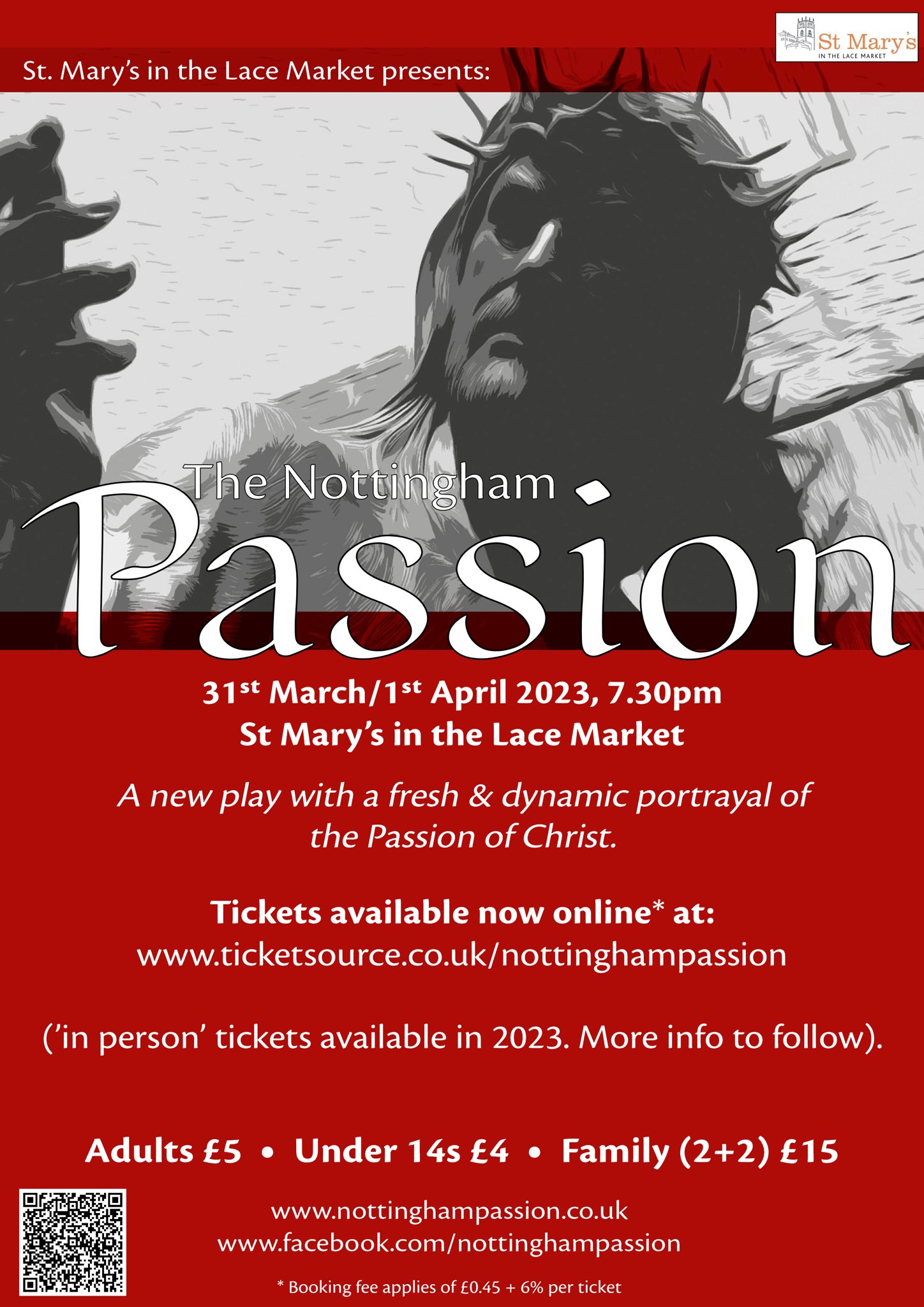
Because, in a few months’ time, I’m going to play the part of Jesus Christ in a theatre production in Nottingham. It’s called The Nottingham Passion at it’s on at St Mary’s in the Lace Market.

Nottingham Passion poster

I’m also a performer, you see.

I’m not a famous performer – it’s unlikely you’ve heard much about me or seen anything I’ve been in. This doesn’t mean I’m a rubbish performer. I scrub up well, and other recycled prose from paragraph two of this blog. 

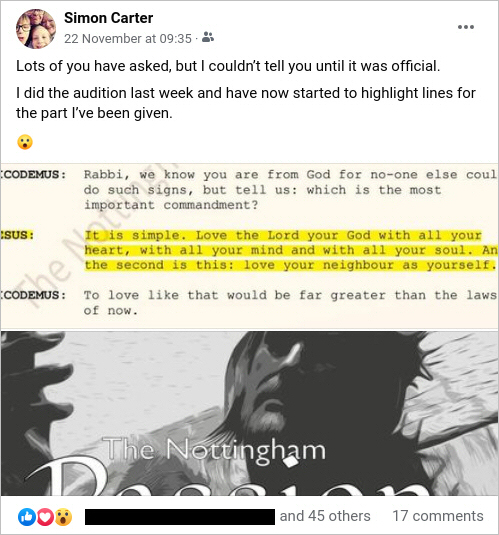
There was an audition I went to back in November last year, one which I very nearly got cold feet about because my self-confidence had taken a real bashing. I went to the audition because I wanted to find a way back into some kind of faith life, find a way back into a church building somehow, and find a way of doing some good with this ‘gift’ of communicating that people keep telling me I have. 

I didn’t know what I was expecting.  I hadn’t done any kind of audition in years. Pontius Pilate, maybe, because I have a Roman nose.

Passion Play 4aBut reading for the part of Jesus and then being cast as him? I guess if there was a shortlist of people in human history who you’d think had come closest to speaking perfect words and taking perfect actions, Jesus would likely be on that list somewhere.

So here I am, staring down the barrel of playing the part of Jesus. I want to do the very best job I can. There’s no way I’m taking this lightly, because doing this is among the privileges of my life. So, I’ll prepare properly and thoroughly, and I’ll try to see and show the events of Passion Week from Jesus’ perspective. It’s a great script, with a great director in the Reverend James Pacey, and many strong voices across the whole cast. Plus it’s live theatre and storytelling, which can be so very powerful in ministry. Here’s what James has to say about the subject.

So, as I consider the various ramifications of that monumental, world-changing few days in Jerusalem two millennia ago, I’ll aim to share some thoughts about how the events of Passion Week might have felt whilst being stood in the shoes (sandals?) of the central figure in all of it.

Jesus is a complex and divisive figure. There’s no real dispute about this, and we sugar-coat him at our peril. I don’t think this production will be pulling any punches.

Matthew 10

Jesus was divisive then, he’s divisive now. Whether you consider Jesus, as Christians do, to be the son of God, both fully human and fully God, or you consider him instead to have been merely a human being who offered some sound moral teaching we can choose to accept, reject or simply ignore, the common ground surely is that Jesus must have been, at the very least, a good and decent man with the very best of intentions. You’d want him on your side, for sure. You’d want him to have your back.

Maybe we could even agree that Jesus was a great man, with hugely important things to say about the human condition, about human struggle, about life, about relationships, about love, about hope, about morality.

Maybe we could agree that he was an immensely courageous and determined man who took unimaginable personal risks to say what he felt needed saying to bring about the possibility of radical change in people and hope for the last, the least and the lost. The truth bombs Jesus dropped about institutional corruption, hypocrisy, and abuse of position and privilege, made him powerful enemies in the religious and political authorities of his day. It was these people who became so hell bent on silencing Jesus and destroying him.  

Jesus was great enough and impactful enough that people are still talking about him some two thousand years later, and whether or not you believe that Jesus was the son of God, history nonetheless appears to record that this man took a series of planned and deliberate actions, over a period of around three years, which he knew would lead to his public humiliation and execution, all with the apparent endgame of saving human lives, human souls, and making all things well, in the end. 

Passion Play 5aLike it or not, welcome it or not, the fella appears to have chosen to die for the human race and, last I heard, that includes you and me. Doubt his authenticity, doubt what motivated him, doubt his state of mind if you like, completely turn your back on the whole concept of it if that’s your choice, but Jesus’ very specific decision appears to have been to die for everyone, whether we wanted him to or not. 

What we make of all of this is up to us. I can’t make you pick up a Bible if you don’t want to. Sometimes I struggle to pick up a Bible myself. That choice is yours, and that choice is mine. But for me, what’s got me searching again, what’s got me passionate again, is the chance to explore this story in a way I’ve never explored it before, learn a bit more about Jesus myself, and show something of who he was and is to anyone who wants to come along and see the show. The tickets are on sale now, and you can get them here.

So, this initial salvo will turn into a series of articles as thoughts and insights occur, and as the rehearsal process develops in earnest. Just so you know, beard growth has been insisted upon.

Thanks so much for staying with me this far already. 

copyright (c) carterbloke, 2023

Links – Nottingham Passion
My Play CHALK – World Premiere!

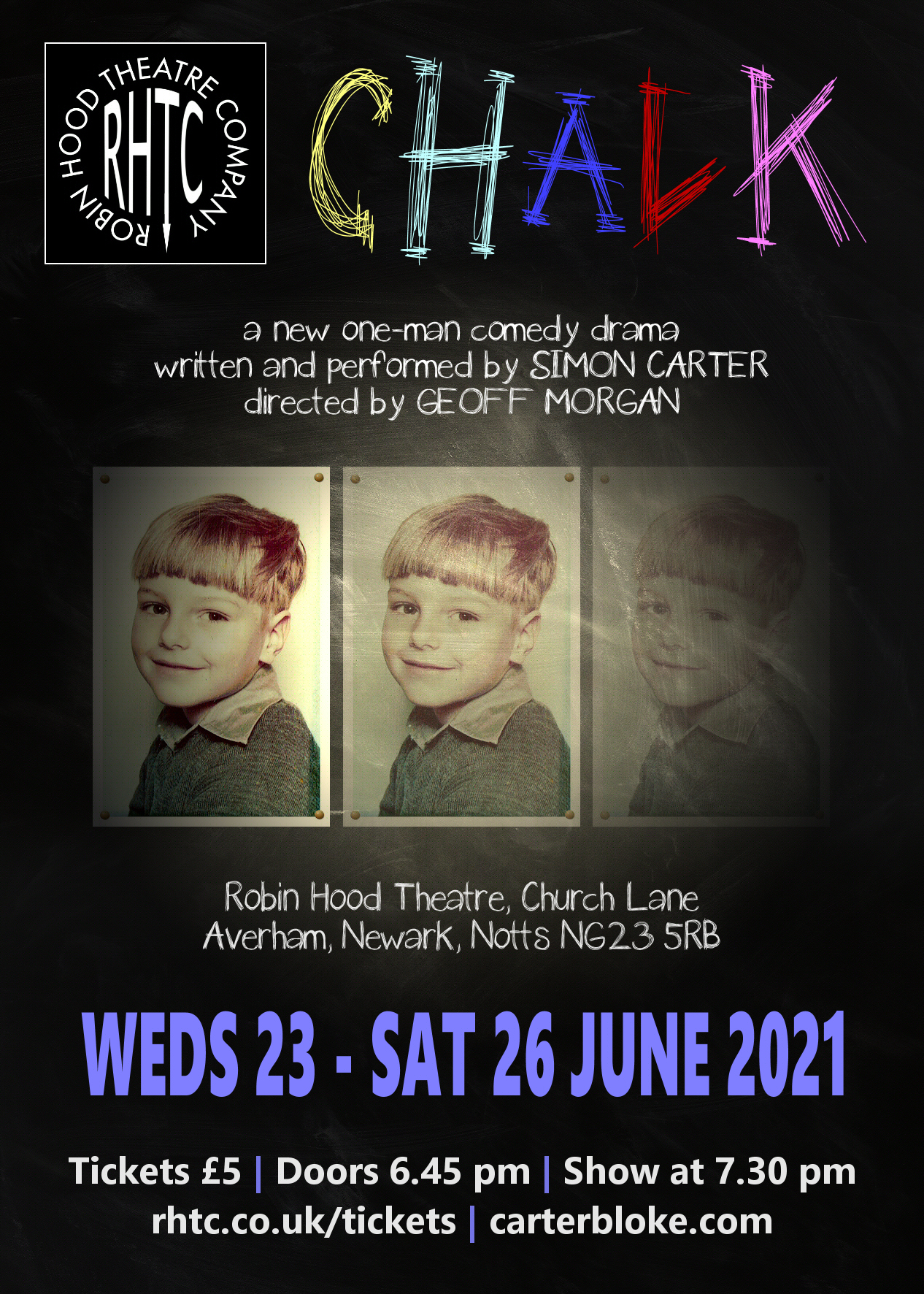
  • As live theatre returns to the United Kingdom, my brand new play CHALK is one of the first out of the blocks in the East Midlands. It’s being staged at the Robin Hood Theatre in Averham, Nottinghamshire, Wednesday 23 – Saturday 26 June 2021. The show aims to raise dementia awareness and funds for Alzheimer’s Society. It’s also a world premiere, so I’m posting my programme notes for posterity!

“IT’S MY ABSOLUTE PLEASURE to be performing CHALK for you at the Robin Hood Theatre. It’s the first time the play has been staged in front of a live audience (which means it’s both thrilling and terrifying for me all at once) and I couldn’t have wished for a better experience in the lead up. Geoff Morgan’s done a terrific job as director and the gusto with which the team has tackled the many technical challenges (I think CHALK now holds unofficial venue record for most single sound and lighting cues in a one act production) has been so impressive. They’ve even built me a giant desk.

The run has been COVID-delayed. We were due to go in November 2020, and then January 2021, now here we are in June. But I remind myself that if it hadn’t been for lockdown I may never have finished the script. This had been sitting around about 75% complete for several years. I finished it initially to be performed by a professional actor chum called Dan Fearn, with an opportunity of getting CHALK into development at the National, where it may still end up.

‘I’ll send it to the Robin Hood Theatre for read-through and feedback at the writer’s group,’ I thought in a moment of rare lockdown proactivity.

Chalk Flyer RHTC 1266x1772

A few weeks later I found myself staring down the barrel of actually performing the thing. Geoff can be very persuasive, and he was keen to get a live piece of theatre up on the stage as quickly and safely as possible. The way things have worked out, it’ll be first production on after official re-opening. Gulp.

It’s for Edith (my grandmother) and Alan (my uncle), both lost to dementia. Alongside other close family, these glorious people were written all over major parts of my childhood.

You may have had, or may have, an Edith or an Alan close to you if you’ve been affected by dementia. What took them in the end was something terrible and devastating, but there were sparks, flashes, in the midst of it. Moments which, when triggered by a familiar voice, a familiar smell, a familiar song, caused them to rise from the darkness and light up the place with a smile, a giggle. In people with dementia, longer-term memory can be prolonged through the hearing of familiar music. An old song can transport you back. It can bring back places, people, occasions.

I never knew for certain what went on behind the eyes, but I did see glimpses. The last time I saw Edith she said to me, in an all too fleeting moment of recall: ‘Oh! Simon! Hello, Simon! Where have you been?’

Simon CHALK v2

I don’t think she saw me as the adult grandchild in front of her. I think, in her mind, I was the five-year-old grandchild again, running around her kitchen with that infernal saucepan on his head, making noises like a motorbike, crisps and crumbs tumbling down his chin. I’m sure this was the version of me nanna clinged to because she’d spoken of it so often before. Forever a child for her, now.

Dementia is a tough subject to write about and I don’t take the responsibility of doing so lightly. I’m hopeful that I can capture of sense of what life might be like behind the eyes of an Edith, or an Alan. I’m hopeful that I can raise some awareness (and some donations) for Alzheimer’s Society, an amazing organisation which does amazing work.

Above all, I’d like to show that for all the distress that dementia causes it surely will not, cannot, ever truly claim a person’s heart, soul and smiles. Who they were, and all they meant to us, stays with us long afterwards. I’m sorry – I don’t want to sugar coat this. Really I don’t. It’s just that I saw this to be true, and twinkling, in the eyes of a loved one as a song, as a voice, took them back somewhere only they knew. Bringing them joy. Release. Dignity in the darkness.

I hope you enjoy the show. Thank you for the opportunity to do it.

And, of course, welcome back to live theatre.”

  • Donate to Alzheimer’s Society via our JustGiving page here.

Strictly Am-Dramming

  • Inside the mysterious world of competitive amateur theatre. This article was first published in HOT, WILD & FREE magazine (don’t blame me – I didn’t name it) in September 2011. 

THE LETTER comes inviting us to Tamworth. It’s £25 to enter and feedback on each play performed at the festival will be given, in public, by the adjudicator. Hurrah!

It’s amateur theatre, it’s the Tamworth Drama Festival and the adjudicator is the expert from the Guild of Drama Adjudicators (GODA) who’ll put one lucky group through to the Regional Final to compete with winners from the other local festivals. Other GODA adjudicators will determine its fate should the group then make the English Final, British Final, World Final, Solar System Final and Universe Final.

I may have made those last three rounds up. It’s competitive, this am-dram lark.

On a Budget

My village drama group says that if you can a) write your own play so you don’t have to pay royalties, b) have almost no-one in it because it’s easier to rehearse, c) not have to hire the venue you’re performing in and d) make sure your set will fit in the back of a Vauxhall Zafira (or similar car), your production’s good to go.

I’m not saying that we’re careful with money but our bank account’s more secure than a combination-lock chastity belt, in a sealed vault with 24 hour CCTV, guarded by a patrol of heavily-armed soldiers, in a castle with an iron portcullis and a moat filled with sharks, on a remote desert island protected by an impenetrable forcefield, whose top secret location is known only to an elite band of deadly ninjas. I mean it. There are ducks’ posteriors less watertight.

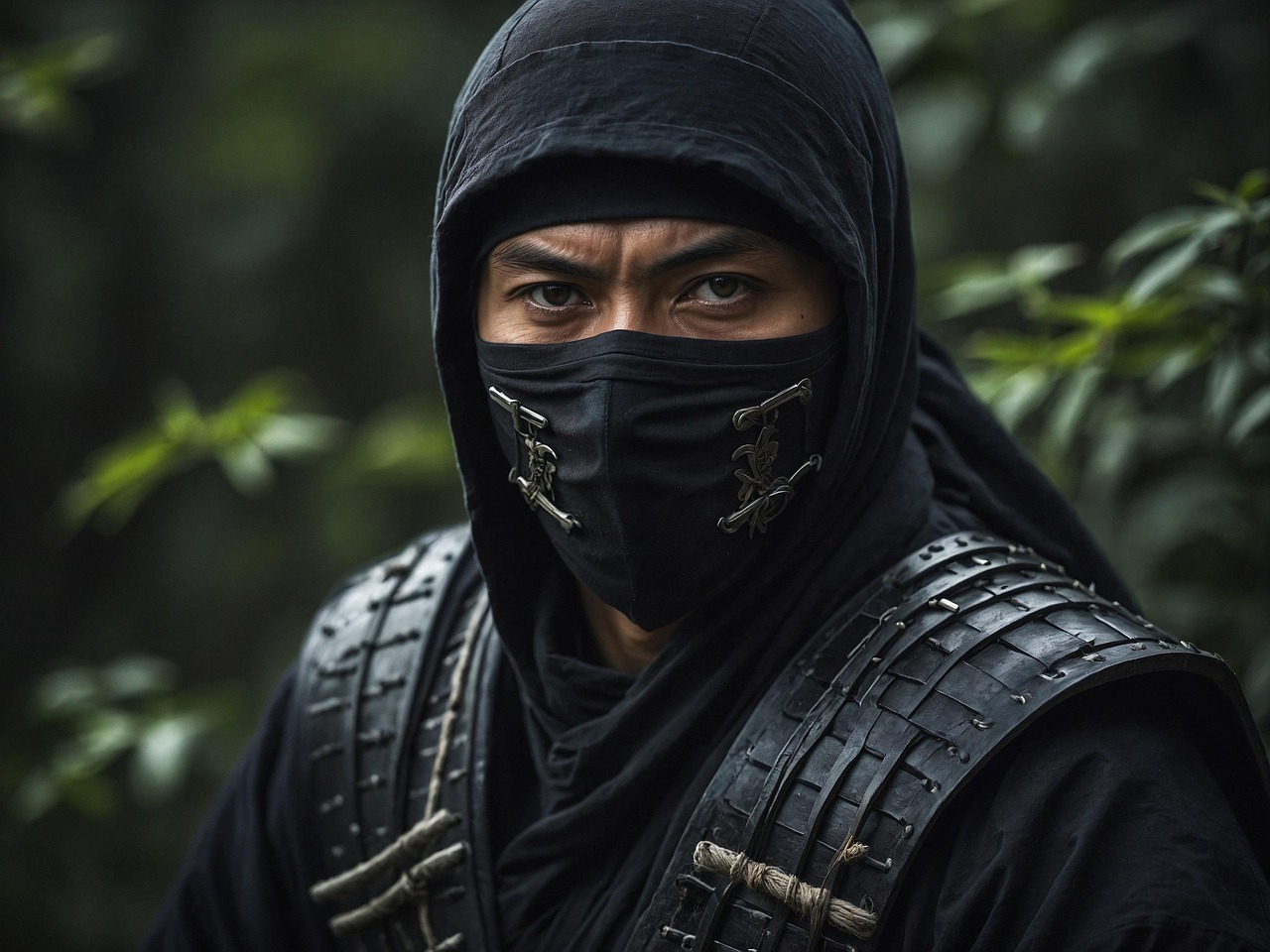
A ninja (Brian), protecting our theatre group’s finances, yesterday

So taking part in someone else’s event for £25 is good because you can just turn up and let other people do the admin. Everything is perfect.

But if it wasn’t for that pesky adjudicator.

One Lovely, One Drunk

We’ve been adjudicated before. Oh yes. First time, a lovely lady called Jill. Adored our show, a one-man play converted to a two-man play to meet the ‘minimum two characters’ entry criteria. She called it ‘wonderful,’ said we’d won and gave us two awards. Great for the cast. But not for the bank account because of budgeting for the next round and expenses for the trophy engraving.

It would be impolite of me to suggest that the next festival’s (non GODA-approved) adjudicator was ‘a little tiddly.’ In his defence, I’m sure his decision to punctuate his feedback on our show by careering haphazardly into furniture was made in our interests. I think he needed the toilet. I’m a father to two young kids and I know a pee-pee dance when I see one.

This bloke didn’t say anything complimentary about our show, a two-man play converted to a three-man play to meet the ‘minimum three characters’ entry criteria put in place to stop a one-man play converted to a two-man play winning all the trophies again.

But then he said we’d won anyway and gave us four awards.

Great for the cast. But not for the bank account because of budgeting for the next round and more expenses for the trophy engraving. They charge you by the letter at Timpson’s. ‘Calverton Theatre Group’ (at twenty-one letters a pop) is really costly so it’s been suggested in future that we either enter rubbish plays with no hope of success or continue to win things but change the name of our group to ‘Jeff.’

Stiff Competition

Anyway. As you move through the rounds of these scarily competitive events two things become clear – 1) the groups you’re competing against are a better standard because, like you, they’ve already won some local festivals and 2) the adjudicators are more eccentric and unpredictable. There’s an escalation in scale of what you have to face to progress. Adjudicators are like baddies in Plants vs Zombies Garden Warfare on the X-Box. More difficult to conquer the higher you go up the levels.

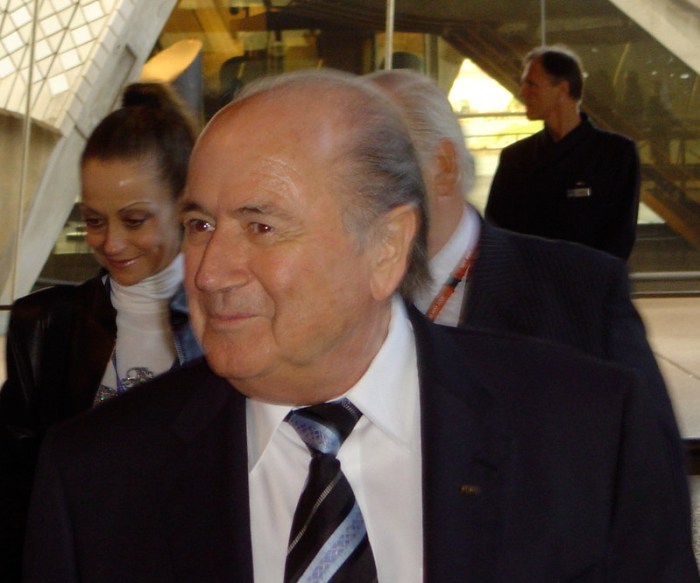
Sepp Blatter arriving at Batley Light Operatic’s recent production of ‘The Mikado’

On balance, everything’s above board (unless you’re mates with the adjudicator in which case the brazen FIFA-esque favouritism can fair take your breath away). But in the end, for all their alleged expertise, adjudicators are fallible human beings judging talent shows, hard-wired like the rest of us to either like something or not. And when you like something, you’re more likely to say positive things about it at the expense of something else you don’t like which may actually have more artistic merit.

The Regional Final

I need to accept that adjudicators either love the plays I write or they hate them. In their eyes I am theatrical Marmite. And when an adjudicator doesn’t like you / is jealous of you / has already decided another group’s going to win anyway so big cheesy cobblers to you, all you can do is try to take the moral high ground. Strangely, the greatest praise given to one of my shows by any adjudicator took the form of two pieces of criticism at a regional final.

Firstly, the basic staging of our show (one chair, no actual set) could, the adjudicator suggested, have been improved by a chorus of heaven’s angels floating around the stage at the show’s opening, ‘as intended by the writer in the script.’ Given that I was the writer of the script and now intended quite differently due to my production budget being non-existent seemed to have escaped him.

Moody production shot of me at Regional Final (illuminated crotch not pictured)

Secondly, we’d botched the final lighting cue. Due to a misdirected spotlight the last thing the audience saw as curtains closed was my illuminated crotch area. A fair point from the adjudicator on this one, because there’s nothing worse than having a show ruined by the final tableau being the actor’s knackers lit up like a beacon. Maybe if we’d brought in the chorus of heaven’s angels right at the end, it would have distracted the adjudicator. I suppose we’ll never know.

The adjudicator said nothing about the writing, or the acting, or that the audience had found the piece so powerful many were moved to tears. Competitive am-dram it seems (and this is its biggest flaw) takes no account of the impact of a play on an audience as a measure of its quality because – heh – what does an audience know?

So in summary. Two picky comments from adjudicator = nothing else to find fault with = resounding moral victory = no trophies = no engraving costs.

Rules is Rules / Keeping it Real

If this isn’t bonkers enough, read the competition rules. Each group has thirty minutes to put up their set and you’re timed with a stop watch. I hold the record for shortest rig at seven seconds, which was how long it took me to pick up a single chair and place it on the stage. I said timing me was pointless. The stage crew timed me anyway. Afterwards I said could they time me again, because maybe I could get the chair in place in three seconds now I’d warmed up a bit. They told me I was taking the Michael.

So why even take part at all, you may ask? Because it’s absolutely blooming brilliant, that’s why. These festivals are quirky, antiquated and arbitrary and I love them. Also, did I mention it’s dead cheap to take part?

If you’re in a group that takes this sort of thing seriously, please accept my apologies. I don’t mean to poke fun unfairly. It isn’t that we lack respect for this wonderful British thespian institution. It’s just that our group has different priorities. We just want to have fun and entertain some people, and that’s really about it. We’re quite happy, thank you, to turn up at an arts centre, do the best show we can, blag a couple of trophies, drive off with our set in the boot, pitch up at a camp site and drink whisky until sunrise.

Richard Burton (as ‘Tommy Tumble’ in the 1968 Felixstowe Players production of ‘Crikey, Vicar!’)

Our acting idols? Oliver Reed and Richard Burton. They’re still with us, you know. In spirit.

And they were certainly with that adjudicator I referred to earlier. You know, the ‘tiddly’ one.

Maybe we’ll see him at Tamworth.

Disclaimer: the author’s suggestion that a GODA-approved adjudicator would be biased – and therefore not judge all plays with complete objectivity – is not intended as a criticism of all GODA-approved adjudicators.

It is, however, based on a real example where it was blindingly obvious to a room full of people – and each of the drama groups taking part – that this is exactly what the adjudicator was.

I’m not bitter.

Please don’t take away any of our nine awards :-)

copyright (c) carterbloke 2011

Photo credits

The following photos used under Creative Commons licence.

Postscript

  • Two more awards at Tamworth. Boom!

Devil Went Down To Blidworth – The Calverton Plough Play

SOMEONE TOLD me once that I was romanticising the whole thing, that I was taking our Plough Play far too seriously. The evidence for this was apparently compelling.

I’m a CRAPPPSoholic

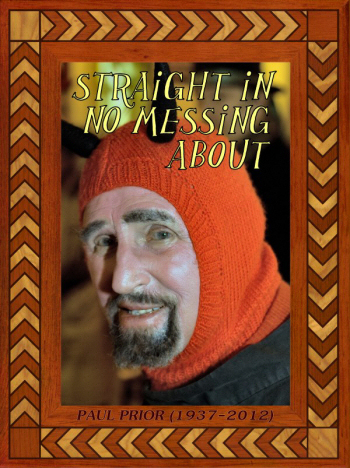
Paul Prior 350x468I’ll admit I was a bit obsessed. I’d just written a screenplay for a movie called Plough Boys based on our group, and I’d just been asked to share the part of Beelzebub with Paul Prior who I now realise I hero-worshipped. It’s no mean feat to keep a voluntary activity going for more than thirty years, to keep the participants keen, to keep the goodwill going. People tend to be flakier these days and don’t seem to stick at things. You try keeping something going that long. Until I met Paul I’d have thought it impossible. But he’d managed it, and I massively respected the fact.

Paul, thirty-plus years a devil in a long-established Nottinghamshire folk tradition. Me, a soft southern jessie from West Sussex. This wasn’t exactly textbook succession planning but the group had decided, with Paul’s blessing, that I should double up with him as Beelzy and ultimately succeed him, and that I should even ask my mother-in-law to knit me my own horned balaclava.

I wasn’t about to take on the responsibility of taking over from Paul lightly but this playful accusation of romanticism, of this meaning far too much to me, had been levelled. Surely this was ‘just’ a bit of old-fashioned nonsense I did round the pubs every January, raising a few quid for charity, and nothing more.

Truth is, I couldn’t respond objectively at the time to such comments. And I can’t now because, for the avoidance of doubt, you need to know that my name is Simon and I’m a CRAPPPSoholic.

Beelzy Hardwick Inn 300x450I run the Plough Play website. I love doing it. I spend something like two hundred hours a year keeping it updated. I don’t have to do this. I keep the Flickr account updated with all our latest snaps which I’m sure must be of limited interest to the population of the Planet Earth in general. I don’t have to do this. And every January I paint my face, pull on three layers of lycra and charge into pubs smacking a bloke in a dress over the head with a squeaky plastic club. I certainly don’t have to do this.

I’ve written scripts for our group including a rebooted St George’s play and a live action Punch and Judy show. I’m writing lyrics for a Plough Play-themed comedy single to raise a few more quid for charity. And I find myself on the bus right now, writing an article about our bloody Plough Play. It’s unhealthy, this hobby I have. There must be tablets I can take.

And one gets reflective as the year draws to a close. With the January 2016 Plough Play on the horizon, I look back at our antics in 2015 and ask myself: ‘Was it all worth it? Do I still love this as much as ever?’

2015 Remembered

Because on the 2015 Plough Play run, I’d been wondering if all the work we’d put into our show really, truly justified what we got out of it. Had we overegged the whole thing? And come the run itself, was I actually enjoying myself anymore?

A couple of gigs into the Friday night and I’d become pretty darned grumpy – a right sulky, stompy prima donna. It was mainly to do with a misunderstanding about who was managing the collection and how we’d forgotten to fetch big enough plastic coin bags because the small ones we had were simply incompatible with my dripping pan. You know. The big, important, world-changing stuff.

But my usual chirpiness and spark was missing completely. Come Farnsfield, I was still a bear with a sore head.

The Lion, Farnsfield

And then The Lion happened. And it was extraordinary.

The pub is packed, the atmosphere is electric and the audience response is stunning. And, being the total show-offs we are, we play up to the pub’s undivided attention. Every line delivered with gusto, every little improvisation met with howls of approving laughter, every little stumble over the lines turned into an opportunity for humour, and a near standing ovation at the end.

CRAPPPS Plough Play 2015 23

And I know that this is no random accident. Because the people in this pub are not here in spite of us but because of us. This is a show based on a script written in 1890, a script that in all honesty can make little or no sense to an audience of pub-goers in 2015. And yet – there are people there finishing our lines for us, mouthing the words back to us, joining in with us. Knowledgeable people, respectful people. Young and old, man and woman, they’ve come out not just to see our play unfold before them, but to be part of it.

And I think: this tradition’s not dead, Paul. On this evidence it’s brilliantly, vibrantly alive.

And I realise: this is so much more than words on an old script and a hodgepodge of colourful costumes. This is about friendship, and fellowship. It’s about heritage, and culture, and community. And it’s a real privilege to have a role to play in this. Lucky, lucky me.

And every man Jack of our team is loving it. Insofar as it’s possible to fuse mumming with rock ‘n’ roll this is as good as it can get, surely.

Fox and Hounds, Blidworth

Then the Fox and Hounds at Blidworth Bottoms happens. The single best gig I’ve had the privilege of being involved with as a Calverton Plough Boy, followed by … the single best gig I’ve had the privilege of being involved with as a Calverton Plough Boy.

For the uninitiated, the way I describe the Fox and Hounds is that it’s the Wembley Stadium of the Calverton Plough Play. Paul’s long association with the pub is the stuff of local legend. On the one year I was lucky enough to share the part with him, there were certain gigs he wouldn’t let me do, like the Fox and Hounds, where he told me: ‘I need to do this one. I’m expected.’

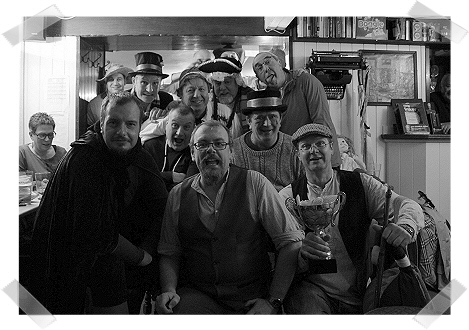
CRAPPPS Team 2015 Tape 600x400

I think back to 2012, when Paul couldn’t make it because he was too ill. I remember walking into the Fox and Hounds as Beelzy (where he was expected and I wasn’t). And the pub caught its breath when it saw me – because not to see Paul standing there meant that there was trouble with Paul. It was exhilarating and heart-breaking all at once, and I didn’t know where to put my shiny, painted face.

Now, in 2015 the pub is standing room only and the show … just … delivers. It’s a rollercoaster ride of absolute, unbridled, adrenaline-fuelled joy to be in the pub, to be part of it.

Nights like this are why CRAPPPS members are gloomy when it’s all over and we know we have to wait another year. Give us the stamina, the liver resilience and the money to subsidise it and we’d probably be out there every night. Just try stopping us.

Woodborough / The CD in the Dripping Pan

So. Collection taken at The Fox, Mole Catchers sung and sing-out finished, Woodborough happens.

Two brilliant back-to-back gigs at Nag’s Head and Four Bells. With the previous two pubs already in the locker, this makes four of the best, four of the very best, Plough Plays I’ve been fortunate enough to be part of and, from mardy beginnings, the best single Plough Play night I’ve ever had.

Somewhere in the middle of it, I discover a CD in my dripping pan, placed there by Peter Millington. On it, I discover an interview CRAPPPS recorded for BBC Radio Nottingham back in 1996.

And there’s Paul on it, and some of the current team, captured in history. And listening to Paul talk it’s like he’s in the room again, egging us on, drumming into us the importance of what this is, and what it means, and why his wish is that this great tradition is kept going.

I’m bowled over when he talks about one day handing over his part to a younger man. He was seventeen years a devil in 1996 and thirty-two years a devil when he last appeared in a Plough Play in 2011. When he first performed as Beelzebub in 1979, his replacement was just five years old, a schoolboy who would one day grow into a soft, southern jessie from West Sussex, writing about his wonderful hobby on the bus.

Moving On

Paul Prior Calverton Echo Tribute 350x391The Plough Play was an enormous part of Paul’s life. It was so important to him, in fact, that he asked to be buried with his Beelzebub costume when he went. Pat Hemstock, vicar of St Wilfrid’s Church in Calverton, ever the voice of common sense and reason, determined they should fold up the costume next to him rather than have him wear it. Paul needed a chance at St Peter’s Gate and being dressed as the lord of darkness wouldn’t help.

Paul was buried with his costume bar one item, mind – the leather pouch, which I now wear with pride on my belt, was his. Paul wasn’t a man of pomp and ceremony. He was never one to make a fuss. But we both understood the meaning of that private, misty-eyed moment at the Admiral Rodney in 2011, last knockings on the Saturday, when he passed that pouch to me, shook my hand and wished me luck. Paul would play Beelzy again, but never in a Plough Play – his last outing as Beelzy was in a St George’s Play in Woodborough on Royal Wedding day, 29 April 2011.

Five years later I’m Beelzy in my own right and I’m wondering how I’m going to make it another twenty-six years, just to keep up with Paul.

Health permitting, I have one wish.

In something like 2050, when I’m deep into my seventies, I want to be looking into the eyes of a younger man and handing him a leather pouch.

And I’ll know the fellow when I meet him.

For all I know he’s just started school.

Me – a romantic?

Absolutely.

But, you see, this is in my bones now. It’s part of who I am.

Also, I made a promise to a jolly old man. I fully intend to keep it.

copyright (c) carterbloke 2015-2019