Talk About The Passion #6 – Truth To Power

IT’S GOING TO BE INTENSE. I write this at the beginning of production week for The Nottingham Passion at St Mary’s in the Lace Market, a wonderful and powerful new theatrical interpretation of the Passion Week story written and directed by Reverend James Pacey (with help, as I understand it, from some other people called Matthew, Mark, Luke, and John).

Work on this project began, of course, much earlier for James and his team of organisers, but for me it started with a somewhat nervy audition at Nottingham Playhouse in November last year and my being cast in the role of Jesus.

If you’ve followed the whole series of blogs from the beginning, you’ll know how my faith has been (and continues to be) a struggle and how, as I’ve gone through tough times, there have been long phases where I’ve questioned how there can be a loving God when there is so much suffering everywhere. If there is a loving God who has a ‘greater plan,how can this plan possibly be served by the seemingly inexplicable suffering of innocents alongside the rise and prospering of real evil in this world? I know I’m not alone in asking these, or similar, questions.

I’ve explained that my perspective has often been that of a frustrated human being remonstrating with God about how he could surely make all the bad things go away, and how he doesn’t seem to do that. I’ve explained how taking on the role of Jesus has pushed me to try to look more carefully at what God’s perspective on this might be.

So far in this series, with deployment of some carefully chosen ‘p’ words, I’ve written about:

Welcome then to blog six, in which we consider the trials and crucifixion of Jesus and how in Passion Week, against a backdrop of betrayal, conspiracy and corruption, Jesus seeks to demonstrate to powerful people (through his willing sacrificial suffering for others) what absolute power truly is.

For those of you who prefer the visuals, here’s the story so far in a really quite groovy diagrammatic format.
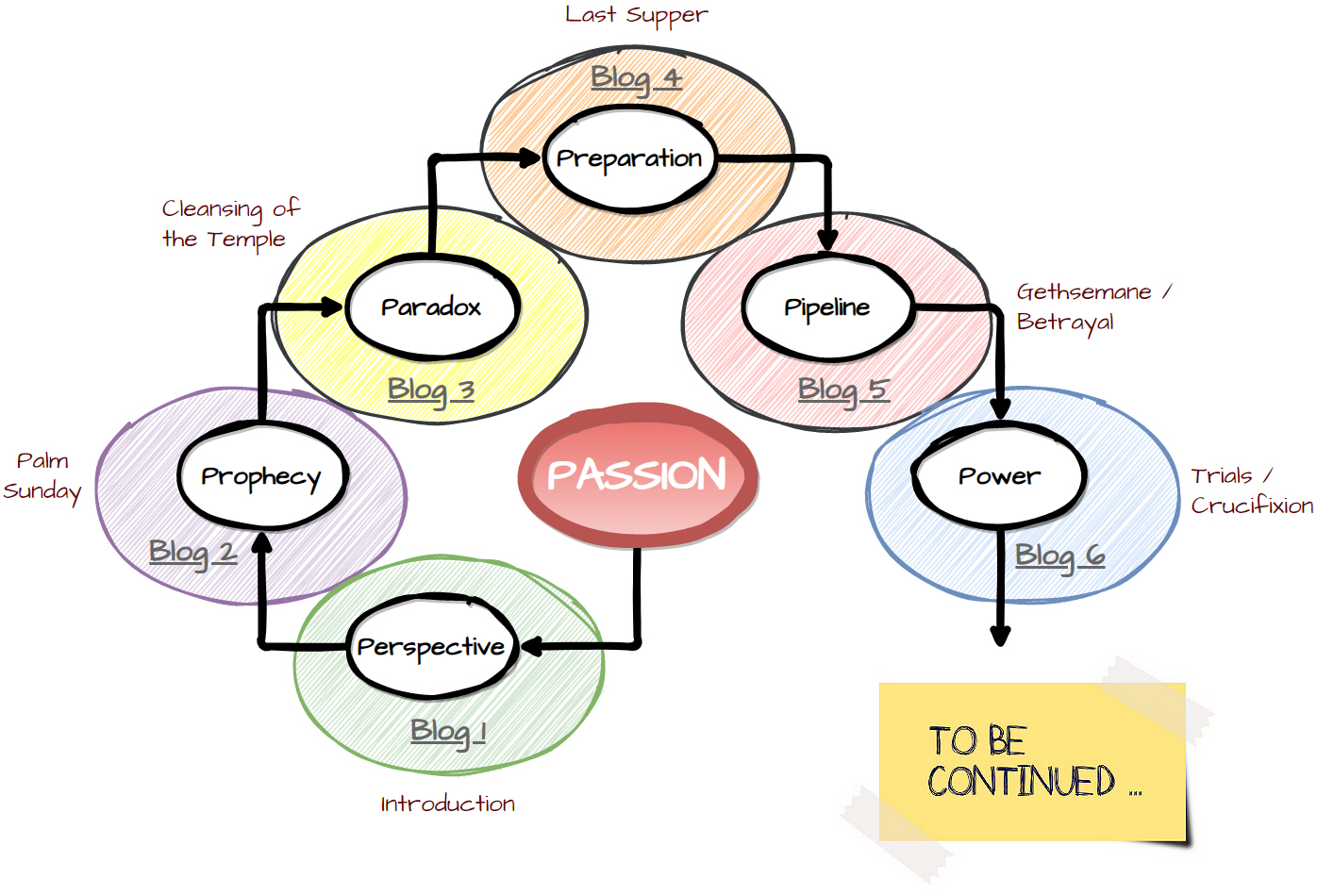
Oh! Also! Let’s not forget those rules of engagement which have helped me (probably more so than you if I’m honest) to navigate my way through this series.

  1. I’m not going to try to answer all (any?) of life’s big questions for you, though I hope there may be something in what I’m writing which prompts you to explore some of these questions more deeply;
  2. I’m not going to preach to you – I have a faith, but this stuff is aimed at everyone, whatever their point of view;
  3. There is no pre-planned structure to this series which ends with me ‘seeing the light’ through my experience of playing Jesus. There’ll be no fluffy, gift-wrapped testimony from me at the end. That would be so twee, and perhaps a little cynical. So, to be clear. I genuinely don’t know how these pieces of writing will develop;
  4. I’m not about to get all ‘pretentious artist’ on you. I’m not that person, and I don’t do this acting lark for a living. I’m a part-time writer and performer who sincerely just wants to do the best job he can, as honestly as he can.

The mental and spiritual agony endured by Jesus in Gethsemane (see blog five) leads, inevitably, to the punishing physical agony of his trials at the hands of the Sanhedrin and Pontius Pilate and, ultimately, his crucifixion. While the stylised nature of our production doesnt show in graphic detail the torment and torture that Jesus undergoes, it doesnt shy away from communicating the stark brutality of the suffering he endures. It’s so desperately sad to see what this innocent man is made to go through. It’s raw, it’s horrifying, and it’s upsetting.

It’s not the purpose of this series to dwell on the complex theology of what the cross represents, and the power of what this man strove to achieve for humanity on Calvary hill on that longest and darkest of nights some two thousand years ago. The purpose is to try to imagine the events of Passion Week from the perspective of Jesus and communicate what it’s like to try to bring that over in performance.

Whether you believe Jesus to have been the son of God, or merely a man, there is little doubt that Jesus had a profound and compelling reason for doing what he did. Jesus appears to have made a deliberate decision to die for everyone, irrespective of how we feel about that and whether or not we wanted him to. His was an act not only of astonishing compassion, but wilful substitution. In simple theological terms, the core message of the gospel is that Jesus takes on accountability for the garbage and mess of all humanity, on humanity’s behalf, so that things are made right between people and God. In our show, we see this signposted in the unspoken exchange between Jesus and Barabbas, unpacked in this video.

There are two aspects of Jesus’ character I’ve been considering while preparing to perform the trials and crucifixion scenes – these are ‘father’s heart’ and ‘total accountability.’

My Christian friend Stuart once told me I had a ‘father’s heart,’ which (derived from some verses in John’s gospel) essentially means having a love-filled heart, with room in it for everyone. If this is true (and I’m not sure, because there are some things which I plainly don’t have a love-filled heart for such as iceberg lettuce, and the musical output of Coldplay) this is a real blessing. But I also think it can be something of a curse. The Christian writer Lewis B. Smedes cautions those with a father’s heart about its flip side, the wearying burden of what he describes as total accountability.

Some of us,’ says Smedes, nurture an illusion that we are accountable for all the ills of the world. In our silly pride, we are stupid enough to suppose that God expects us to carry on our little backs a load that only Jesus can bear. (Total accountability) besets sensitive and moral people. … The more sensitive you are to other people’s troubles and your own responsibility, the more vulnerable you are.’

This speaks to me hugely. Maybe it does to you. I would never want to stop listening to people about their problems and trying to help them if I can. As Chris Martin famously sings: ‘I will try to fix you,’ even though it’s simply not possible to fix the great majority of Coldplay songs. The desire to want to help people feels innate and instinctive to me, but as many well-meaning friends, family and workmates have told me so often in the past, I can’t help anyone if I’m a shipwreck, and that means having to put myself first sometimes.

No mere mortal can carry the weight of the world on their shoulders. No-one person can help everyone. No-one person can save everyone. But Ive had the rare honour and privilege to walk a little in the shoes of someone who I’m increasingly beginning to believe can do each of those things.
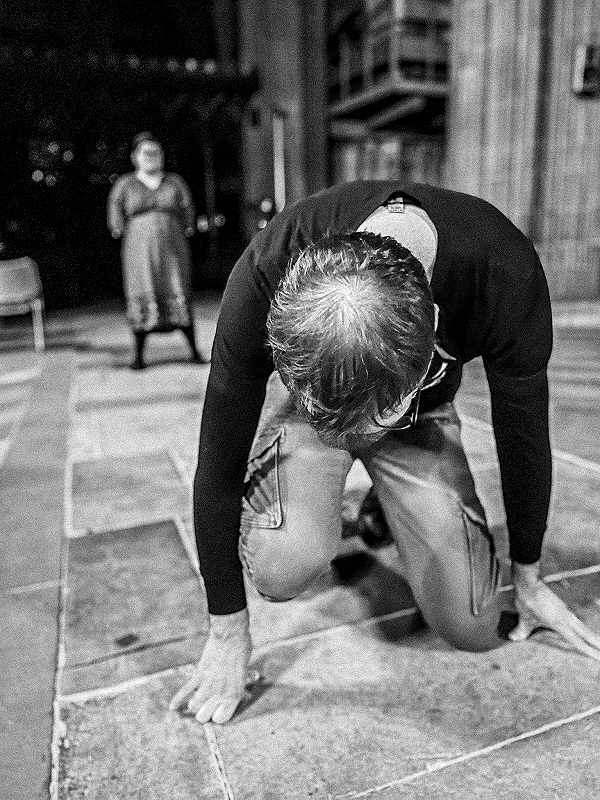
To be clear, it’s not like Jesus didn’t do self-care. Accounts of him taking time away to be alone, to pray, to rest, to replenish, are there in the gospels. Jesus’ ministry necessarily came with downtime, because being fully human came with the risk of being fully exhausted if he didn’t take opportunity for pause. Even Jesus was at risk of burnout. It’s reasonable to assume, therefore, that there were occasions when (whisper this) he needed to put his own wellbeing first so that he could then best attend to the wellbeing of others.

In attending to the wellbeing of others, though, the difference between Jesus and mere mortals comes squarely in that ‘total accountability I speak of.

‘Total accountability,it seems, becoming accountable for all the ills of the world’ as Smedes describes it, is a load that only Jesus is equipped to bear. The physical weight of the cross which Jesus carries is symbolic of the infinitely heavier weight he carries in bearing the sins of humanity on his shoulders and dying so that ‘all the world shall find salvation and forgiveness’ (checks own lines from Gethsemane scene – correct!).

We’re not built to bear such a load, and we shouldn’t pretend to be, no matter how well-meaning we are, no matter how genuine and honourable our intentions.

But what does all this mean in performance terms? What’s going through my mind as I’m getting ready to act it all out this week?

Let’s start with a tenuous boxing metaphor (or a wrestling one if you prefer spandex). In the blue corner stand the Sanhedrin (Jerusalem’s religious authorities) and Pontius Pilate (governor of the Roman province of Judaea), there to put Jesus on trial for his supposed blasphemies and to pass sentence. In the red corner stands Jesus itinerant rabbi, champion of the last, least and lost, speaker of uncomfortable truths, worker of miracles, signs, and wonders.

Who’s your money on here, folks? Who has the power? This doesn’t seem like a fair fight, at least on parchment.

Is Jesus powerful or powerless?

As an ordinary human being trying to act this stuff out, it can feel like both of these at once when I’m in the middle of it. I don’t have very many lines to speak in the trial scene with the Sanhedrin or the scene where Jesus is interrogated by Pilate, but I’m there onstage. It puts me in the somewhat unusual position where I can be an observer of the scenes as much as a participant in them.
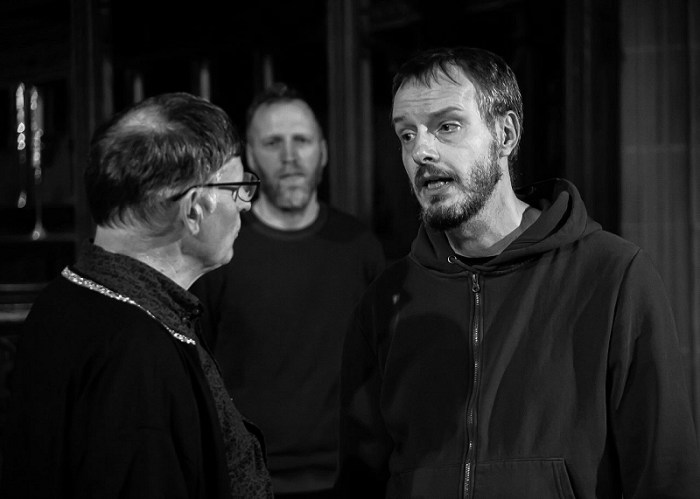
It feels like the walls are closing in when I do the trial scenes. It’s such an appalling sequence of events. The things they put that innocent man through. In strictly human terms, Jesus has no power at all here. He’s isolated. He’s fearful. It’s ruthless, relentless, what they’re doing to him. He’s being abused. Brutalised. He’s taking it all, and presumably he doesn’t have to, given that he’s told his disciples that if he willed it, God would unleash actual angels to defend him. Jesus stands down the angels, relieves them of their service, endures the cruelty.

A man with a God within him who we know from Old Testament accounts is able to destroy and destroy utterly. There is such power in Jesus’ restraint when surely rage would seem the most appropriate human response. And Jesus takes the punishment anyway, when it should be Barabbas, when it should be someone else, anyone, everyone, but him. I’m pretty much shaken to my core before the cross even arrives at the crucifixion scene.

And then there’s the crucifixion scene. It’s impossible for me to know what it looks like to an audience because I’m in the midst of it, but it feels so, so very sad every time I do it. I think the scene has a unique beauty and a power all of its own, and it will affect different people in different ways. For me, as a person with a faith, the only words which appear in any way appropriate when it comes to speaking with Jesus about re-enacting this sequence of events are: ‘thank you.’

From an ordinary human being perspective on power, then, to a fully human / fully God perspective on power. This other perspective is explained in Jesus’ few, but extraordinary, words to Pontius Pilate – Pilate, with all of the power he thinks he has.

‘You would have no power over me,’ says Jesus, ‘unless it had been given to you from above. I was born, and I came into this world, to testify to the truth.’

Pilate asks Jesus what truth is, unaware it’s looking right at him. Right at him.

It’s not the first time our show examines the issue of power. Nicodemus, the Pharisee, seems to get Jesus, and the power that is in him, right from the start. In an early scene, Nicodemus says to his fellow Sanhedrin members: ‘How right Jesus is about us. Power and status are difficult things to let go.’

Nicodemus sees a bigger picture that his counterparts cannot see, sees true power as something so much bigger than earthly power, bigger than status, bigger than control and enforced conformity, bigger than privilege, bigger than human-made law itself. Nicodemus senses in Jesus a complete redefining of power, an embodiment of true power, with love for God and love for each other at the heart and mind and soul of all of it – a power that is beautiful, pure, incorrupt and incorruptible, no matter what cowards, tyrants and monsters would do to thwart it. It’s a power, an absolute power, that will endure down the ages.

I’m fond of what Lord Acton famously said to Bishop Creighton about power, even though he has it only half right in my view.

In Jesus’ eyes, power tends to corrupt. But absolute power conquers absolutely.

To finish, my friend Mark suggested to me at the beginning of this project that the experience of playing Jesus would change me. I think he was right. It’s been a series of incremental changes rather than huge epiphanies, but there have been changes nonetheless. Portraying Jesus of Nazareth has been quite the task for Simon of Calverton. I still don’t have answers for any of life’s big questions (I don’t think that was ever a realistic outcome to expect from this) but what I’ve learned, and am still learning as I go, has helped me. I’ve become less frustrated these past weeks and months, less exasperated, more level-headed, more patient. Life is a longer game, and the world’s problems do not have quick fixes.

Ten years since I was baptised now, and maybe this is me accepting that no one person can solve all the world’s problems on their own, or reasonably be expected to try. Maybe this is me being kinder to myself and accepting that anger at the state of the world, and the raging at the machine, shouldn’t be at the heart of a person to the exclusion of everything else.

Anger, unchecked, can become all-consuming. It can diminish our hope, steal our joy, make us part of the problem rather than part of the solution. We can grieve at the almighty mess we’ve made of the world; we can strive to make a change through positive action and activism (because faith without action is dead), but anger achieves little in the end though it may be where any change worth making starts. Even God himself realised this, when he came down to earth in the form of a man called Jesus and found out first-hand what it was like for us – Old Testament God giving way, through Jesus, to another, better, more relational way of dealing with people.

Hey. Maybe this is me accepting my limitations and working out what grace is. Maybe this is me growing up. Shh! Don’t tell my friends.

This blog takes us all the way into the public performances of The Nottingham Passion on Friday 31 March and Saturday 1 April. Tickets for both performances have long since sold out, but you can apply for any returned tickets by sending an email to nottinghampassion@gmail.com.

Next week, after the performances have finished (and I’ve had a long overdue haircut and shave) my plan is to conclude this series by writing about the resurrection and Great Commission scenes which comprise our show’s finale and offering some final retrospective thoughts about how everything went for Team Nottingham Passion during production week.

Thank you, as ever, for walking with me on this.

copyright (c) carterbloke, 2023

Links – Nottingham Passion

Talk About The Passion #5 – Your Will, Not Mine

I’M PLAYING JESUS in The Nottingham Passion at St Mary’s in the Lace Market this Easter. ‘This Easter’ is imminent, of course, and our company will soon be unveiling its interpretation of the Passion Week story in a wonderful and powerful new theatre production written and directed by Reverend James Pacey.

Followers of this series of blogs will know that I’ve been getting to grips with the various challenges of getting ready to portray Jesus and have been writing some performer’s reflections on these throughout the rehearsal process.

So far, I’ve written about:

Welcome then to blog five, in which we consider the agony, betrayal and arrest of Jesus in the garden of Gethsemane and the abandonment Jesus is made to feel – not just the physical abandonment by his disciples, who will scatter and flee from him in disarray, but spiritual abandonment by God. Yes. You read that last bit correctly.

As ever, there are rules of engagement for readers who may be wondering (or have just forgotten, admit it!) why I’m writing this series. You can find these rules, perhaps unsurprisingly, under the picture below which says: ‘Rules.’

Told you!

  1. I’m not going to try to answer all (any?) of life’s big questions for you, though I hope there may be something in what I’m writing which prompts you to explore some of these questions more deeply;
  2. I’m not going to preach to you – I have a faith, but this stuff is aimed at everyone, whatever their point of view;
  3. There is no pre-planned structure to this series which ends with me ‘seeing the light’ through my experience of playing Jesus. There’ll be no fluffy, gift-wrapped testimony from me at the end. That would be so twee, and perhaps a little cynical. So, to be clear. I genuinely don’t know how these pieces of writing will develop;
  4. I’m not about to get all ‘pretentious artist’ on you. I’m not that person, and I don’t do this acting lark for a living. I’m a part-time writer and performer who sincerely just wants to do the best job he can, as honestly as he can.

You won’t be surprised to learn (if you’ve been with me to this point) that I’ve been developing a bit of a thing for ‘p’ words. Perspective? Prophecy? Paradox? Preparation? These are all well and good, but how about pipeline for blog five? By this I mean Jesus’ connection to God. I mean Jesus’ driving force – his source of spirit, light, power, inspiration, replenishment, solace, everything. What happens when that’s taken away from Jesus? What happens to the son of God when he feels that God has gone? What must that agony be like? And how do you try to represent it in performance?

I’m getting better with this new diagramming software, by the way.

At Gethsemane, for the first time in Jesus’ human life, he experiences what it’s like to feel total abandonment and isolation. What happens to Jesus in the garden is terrifying, and in enduring it, he becomes more complete a human than he has ever been. In his abandonment Jesus comes to know true fragility, true vulnerability, true heartbreak, true isolation, true fear and (whisper this), true doubt. True, pure, raw, humanity. The gospel writer Luke records that Jesus: ‘being in anguish … prayed more earnestly, and his sweat was like drops of blood falling to the ground.’

This chapter in our story is not so much Passion Week as Passion Bleak. Gethsemane, put simply, is darkness. It’s desolation. It’s torment. If the trials and the crucifixion show Jesus in the extremes of physical agony, Gethsemane is Jesus in the extremes of mental and spiritual agony. It’s unrelenting, visceral, excruciating. And it’s the point of no return for Jesus. It’s here in the garden that any ordinary human being, any lesser mortal, might well have capitulated to the sheer, naked terror of all of it and fled for their life.

But Jesus is no ordinary human, and chooses differently.

Once betrayed, once arrested, once in Roman clutches, Jesus knows there will be no turning back. Once the events of Gethsemane play out as predicted, Jesus, alone, incarcerated and left to his fate by his disciples, will find himself on a trajectory that leads to trial, humiliation, torture and death. From Gethsemane, this can go only one way for Jesus.

How remarkable, then, that he does it anyway.

I’ll admit that I’ve had some real worries about doing the ‘let this cup pass from me’ monologue in the Gethsemane scene. More so than the crucifixion scene (where my most acute fear is accidentally braining a member of the audience with my cross as I lug it down the aisle in the church), and more so than the Last Supper scene where I don’t want to make a Horlicks of the world’s first ever communion (for clarity, the Gospels say there was wine in the cup, not Horlicks), the Gethsemane monologue is the one where I feel the most pressure.

I know I should try not to overthink things (which I can’t help, by the way – it’s how I was fearfully and wonderfully made) but I want to do a good and honest job with this speech because it means such a lot to me. I haven’t looked at how other actors have done it, and I won’t. I’m really not fussed about being compared to famous pretend Jesuses and how they did things yonks before me, though for the avoidance of doubt my beard is now considerably longer than Robert Powell’s was when he did Jesus of Nazareth in the 1970s (what a part-timer).

What I am fussed about, I guess, is doing a truthful performance which doesn’t stray into a trite ‘look at me!’ actor cliché. I’m not in this for me. I’m not in this to make a name for myself. I don’t want to act full-time. Stuff that. The simple truth is that I prefer to write, and for others to perform. I’m an introvert that way. Extrovert is fine if it’s a character I’m playing.

But I can promise you that I’ll give it my all. Heart and soul. I’m especially determined that the way I show Jesus won’t conform to the somewhat pedestrian default expectation people often have about church drama productions – that this will be a safe / fluffy / by the numbers staging of a bible story by a group of well-meaning ‘amateur’ performers.

Again, stuff that. I respect the man, and his story, and all it means to me, far too much for that to happen. Safe? Fluffy? Not words you could, or should, apply to Passion Week.

Others in the cast have similar views. They’re not holding back either. For some, this is not so much a dramatic performance as an act of service, or an act of worship. As I think about it now, it’s not the first of these things for me so much as the other two. You’ll know that I have a faith from what I’ve told you here, but you should also and absolutely know that my faith in the fella I’m pretending to be has got me through so much horror and trauma in my life that there’s even a fourth thing for me in this – performance, service, worship … and thanks.

Because if I ever get to meet him, and look him in the eyes, the first thing I’ll do is tell him: ‘Thank you, rabbi.’

Until then, this is the next best thing. So off I go.

A quick aside if you were triggered by me dropping the ‘a’ word earlier. Do you enjoy performing but don’t do it for a living? I’ve got your back. ‘Amateur’ is one of my least favourite words in the English language because it’s used so dismissively in the same universe where ‘professional’ by definition includes people appearing on Celebrity Love Island.

‘Cuddle’ is my favourite word in the English language, for balance.

It’s just that the last time I checked, ‘amateur’ doesn’t mean ‘bad.’ It’s not like this production is the Dibley nativity, though I reckon James could find a spot in our show for Dame Darcey Bussell if her people talked to James’ people.

Quick aside ends!

I know, rabbi. Because sometimes there’s a need for jokes so we can breathe out after the serious bits, right?

This wonderful company of performers (which includes people with a faith, people with none, and people who are unsure either way) are determined to tell this story powerfully, and truthfully, and leave nothing out there on the pitch, with apologies to readers who take the view that religion, politics and Match of the Day shouldn’t mix.

So it’s not about showing off. It’s about showing him.

This is particularly resonant for me with the Gethsemane speech, and I know I was worried about it because I made this video before we’d even rehearsed it once.

We’ve been making videos about preparing to perform, and the Gethsemane video has been the most impactful by far. Other videos in the series haven’t been nearly as insightful (with some of them being downright silly). I don’t mention this enough, but there’s been a generous, gentle and joyful spirit throughout the whole rehearsal process, with many awesome moments of light relief and humour. It’s been important to me to try to capture a sense of the joy of it all as I’ve been going along. There’s even one video in this collection where I do Jesus lines in eight comedy voices in three minutes. Really. You’re welcome.

But when I revisit the Gethsemane video, I realise just how deeply affected I’ve become by this entire project and the role I’ve been asked to play. I’ve become somewhat carried away with it. ‘Swept up’ maybe.

James was interviewed by Nottingham’s Left Lion magazine last month about his creative approach to the project. I was struck by one of his observations about drama and liturgy being about: ‘real, honest, truthful storytelling.’ I realise that through my experience on this I’ve become something of a living proof of concept.

‘The best, most affecting worship is like theatre when we are completely swept up in the narrative being presented,’ says James. ‘When we truly believe what we’re doing, something powerful and inexplicable takes over.’

I can attest, I think, to the ‘something powerful’ taking over, but I can’t explain the ‘inexplicable’ part because if I could, it wouldn’t be ‘inexplicable’ because I’d explained it, which is the opposite of ‘inexplicable,’ and I’m overthinking it all again, so I’ll have to get back to you on Wednesday.

I wholeheartedly relate to the ‘truly believe what we’re doing’ part. I don’t necessarily mean ‘believe’ in a faith context, more in the context of ‘immersion’ where you’re just so into what you’re doing that commitment, integrity and conviction come as standard. When you can find something in the material you’re working with which connects powerfully with you, and you’re able to draw something from within yourself which helps you to feel, speak and give life and depth to that material, then you’re at least halfway to truthful storytelling.

As I said way back in blog two, in preparing to portray Jesus as authentically as possible, I clearly have no comparable lived experience of being fully God and fully human to draw upon. But to tell a story well I think that a performer needs to find some points of engagement and connection with the character whose story they’re telling, otherwise the character’s words are just words on a page, devoid of any true meaning.

You need to try to feel it, so you can believe it, so you can meaningfully show it.

And here I am, sounding just like the theatre geek mafia I also spoke about in blog two (did you get round to googling the words ‘Uta Hagen method’ by the way?).

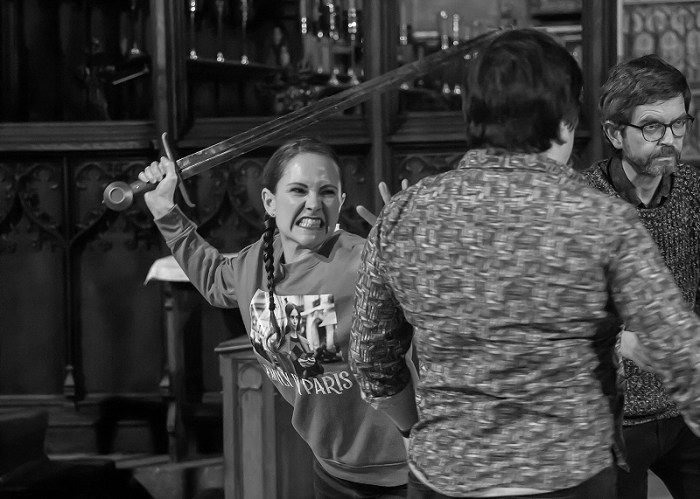
Anyhow, here’s our Becky below (as Simon Peter) ‘meaningfully showing it’ at rehearsal with a flipping big sword. Spoiler! Our Gethsemane scene features a brilliant fight sequence choreographed by amazing professional fight director Kaitlin Howard.

Here’s where I was going with this.

You don’t need to have been Jesus, kneeling in a garden, crying his eyes out, pouring his heart out, to know about abandonment, and to show to an audience what abandonment looks like. I’ve known how it’s been to feel abandoned in my life. How about you? I’ve known how it’s felt to not want to have to endure something, to not want to go through an ordeal. How about you? I’ve known how it’s felt to want something stark, painful and terrifying taken away from me. I’ve known how it’s felt to not understand the reason why I must do the something stark, painful and terrifying. How about you?

You don’t have to believe that Jesus was the son of God to believe that Jesus knew about human suffering. It’s beyond doubt that Jesus experienced human suffering himself. He’s been where we’ve been, felt what we’ve felt. So much more besides.

Gethsemane is human suffering writ large, and the abandonment that Jesus feels is the worst abandonment of all. To feel, in his agony, that God is absent. To feel utterly alone in the universe. I think that many of us will have felt this way in our darkest times. Such a desperate speech.

It seems to me that the themes touched on in the Gethsemane scene (and indeed across the whole play) are so universal as to be relatable to everyone, wherever we stand spiritually.

As James says in the Left Lion article: ‘whether people believe or not, the story touches on a profoundly emotional, spiritual level … the themes of sacrifice, love, betrayal, and desperation – it has it all.’

On the subject of ‘betrayal,’ that’s the mighty Ade Andrews (aka. Ezekial Bone, Nottingham’s own Robin Hood) as Judas Iscariot giving me a traitorous peck on the cheek in the picture below. It’s to Gethsemane, of course, that Judas Iscariot leads Roman soldiers to arrest Jesus, identifying his master by kissing him on the cheek.

The betrayal of Jesus is a beautifully directed sequence, and Ade does what he does wonderfully in it. At this point I’m under instructions not to give too much away about how the action plays out. Don’t worry, theology buffs! Judas still betrays Jesus! We haven’t messed with the gospel!

But you might want to rain check those boos and hisses in the light of what you see. Let’s just say what you see might defy expectations.

You didn’t want something safe and fluffy, did you?

Thanks, as ever, for coming along. Next up for Jesus? The trials and the crucifixion.

copyright (c) carterbloke, 2023

Links – Nottingham Passion

Talk About The Passion #4 – Servant King

I’VE BEEN CAST AS JESUS in The Nottingham Passion theatre production at St Mary’s in the Lace Market this Easter. If you’re reading this without having checked out earlier instalments, I’d suggest going back on those first. It’s not a great idea to come into any story at episode four, unless it’s Star Wars, which is the only exception to this rule I can think of.

To be clear, this series of blogs bears no resemblance to the Star Wars movies. If anything, there are many significant differences, like the first three episodes in this series of blogs being well written. Reverend James Pacey (pictured above), our production’s director, once politely took me to task about mocking the quality of Star Wars scripts, so it’s possible that by the time you’ve finished reading this I’ll have been sacked from The Nottingham Passion for mocking the quality of Star Wars scripts again.

Spoiler: James prefers Star Trek. I may be okay.

To recap.

In blog one, I wrote about how I’ve found my faith difficult and how being cast as Jesus has caused me to consider how the events of Passion Week might have felt from the perspective of the central figure in all of it.

In blog two, I wrote about how Jesus may have experienced the events of Palm Sunday. I shared my thoughts on how Jesus seemed to have seen in people an absolute beauty that they couldn’t see in themselves, and how Jesus’ powers of prophecy may have made the triumphal entry into Jerusalem feel less than triumphal to him. For all the hurrahs and hosannas, Jesus knew the crowds did not understand who he really was and why he had come.

In blog three, I wrote about Jesus as a paradox – the complex challenges that must have been part and parcel of simultaneously being fully human and fully God. I suggested that an example of this (as shown in our production) might be the Godly rage and righteous anger tempered with human restraint that Jesus shows when cleansing the temple of the merchants and money changers.

You’ll see that I’ve called out three ‘p’ words above – perspective, prophecy, and paradox. Do you see where this might be going?

In a possible minor violation of rule 3 below, I appear to have worked out a way of setting out my thoughts in (gasp!) some semblance of order and sequence. I don’t usually ‘do’ alliteration, but hey. Here we are in this blog, looking at the Last Supper and how that hugely significant gathering in Jerusalem’s Upper Room two thousand years ago saw Jesus share with his disciples a model of humanity and love for others so extraordinary that it would become a catalyst for a sequence of events that would utterly change the world. In Jerusalem’s Upper Room, Jesus knew what was coming, and he knew how critical it was that his disciples were prepared for all that would follow.

Oh no! There’s a fourth ‘p’ word now, and a lovely graphic and everything because I’ve been testing out some new diagramming software.

If you’ve kept up with the series so far, you’ll know there are some rules of engagement as below. Don’t worry! Rule 3’s still intact. I can still promise there are no twee testimonies or stage-managed epiphanies coming at you later. Rest assured that the purpose of the series remains the same – to provide some reflections on how I’m preparing to play the role of Jesus, and how I’m trying to see and show the events of Passion Week from his perspective.

  1. I’m not going to try to answer all (any?) of life’s big questions for you, though I hope there may be something in what I’m writing which prompts you to explore some of these questions more deeply;
  2. I’m not going to preach to you – I have a faith, but this stuff is aimed at everyone, whatever their point of view;
  3. There is no pre-planned structure to this series which ends with me ‘seeing the light’ through my experience of playing Jesus. There’ll be no fluffy, gift-wrapped testimony from me at the end. That would be so twee, and perhaps a little cynical. So, to be clear. I genuinely don’t know how these pieces of writing will develop;
  4. I’m not about to get all ‘pretentious artist’ on you. I’m not that person, and I don’t do this acting lark for a living. I’m a part-time writer and performer who sincerely just wants to do the best job he can, as honestly as he can.

By the way, I’m not adding this as an official rule 5, but I’d suggest buying your tickets as soon as you can, because they’re selling out. Here’s the poster, and the rest is up to you.

It’s traditionally called ‘the Last Supper’ because it’s the last meal Jesus was able to share with the core group of twelve disciples before his arrest. There would be other chances for Jesus to break bread with gatherings of disciples (such as on the road to Emmaus following the resurrection) but we’re not there yet.

For now, at this point in the Passion Week story, the Last Supper would seem to be coming down the tracks with all the foreboding, impending sorrow and grim sense of finality you’d expect to have to teach spotty students like me in any typical GCSE Religious Education syllabus of the late 80s and early 90s if your name was Mrs Maureen Gleason and you were a member of staff at the Angmering School in West Sussex.

I know this reference sounds very specific, and quite possibly very specific to me and my RE teacher, but I’d always been taught that the Last Supper was just so very … well. Last.

Please don’t misunderstand me. In my life I’ve been to many organised dinner gatherings where there has been foreboding, impending sorrow and a grim sense of finality. But this is what you get with some family weddings.

At a superficial level, there is something which feels so brooding and ominous about the Last Supper. But at a deeper level, if we look at what Jesus does and achieves at that momentous gathering in Jerusalem’s Upper Room, through powers of communication rich in compassion, empathy, and intuition, surely the Last Supper is far from brooding and ominous. It’s far some sorrowful. It’s one of the most significant and empowering events in world history.

The fullest account of the events of the Last Supper is found in John’s gospel. It’s been necessary to distil this into a reduced account for our production, but each of the core components remains intact without any reduction in the scene’s power. And the scene is so powerful. We’re making some videos about the process as we go along, and here’s one all about the Last Supper.

When it’s boiled down to its basic elements, what seems most remarkable to me is how Jesus communicates such tough, heart breaking, messages to his disciples. The actual simplicity of how he approaches it, the emotional intelligence he displays when he does it, how Jesus connects with his disciples so impactfully and powerfully, ensuring clarity of instruction as well as throwing in some beautifully balanced tough love and consolation for good measure, is nothing short of extraordinary. Supernaturally extraordinary.

You need a role model for effective servant leadership? Throw out the name of any celebrated self-help guru or life coach, and I’ll raise you Jesus. Throw out How to Win Friends and Influence People, or similar volume, and I’ll raise you what Jesus models at the Last Supper. As I’ve said in previous blogs, whether you believe Jesus to have been the son of God, or instead to have been a mere human being who had some interesting things to say about love or morality, he surely must, as a minimum, have been a wholly decent man with decent intentions. And he surely must have been the most consummate, authentic, influential communicator of all time.

The Last Supper is a masterclass in communication and leadership. It isn’t Jesus preparing himself for the ordeals which are coming (his own preparation for these will come in the garden of Gethsemane and in the subsequent trials at the hands of the Sanhedrin and Pontius Pilate), this is Jesus preparing his disciples for the ordeals which are coming.

For the disciples these ordeals will include the devastating trauma of Jesus being ripped from them, the bitter introspection, the savage self-loathing, of having deserted and denied their lord, master and best friend. These ordeals will include picking themselves up, summoning the will and strength to raise themselves from their respective pits of despair to reunify and then begin to build a movement in the memory and model of the one whom they loved and lost. These ordeals will include carrying on without him.

Turns out this Last Supper was quite the dinner engagement.

At the Last Supper Jesus shows, as well as tells. It’s who he is. It’s how he operates. It’s in his nature. He shows the disciples what to do. He explains to them why it’s important. He asks them to do it too. And then he asks them to show everyone else, after he’s gone. And in case they might forget, he shows them something to remember him by.

‘Thaddeus? Pass me some bread.’

There’s almost perfect symmetry in it. There are two practical activities bookending the scene. The washing of the disciples’ feet by Jesus, and the taking of the first communion, the inaugural breaking of bread (body broken) and drinking of wine (blood spilled).

In between the practical aspects there are the pedagogic aspects (‘I am the way, the truth and the life … I shall give you a new commandment’) and the prophetic aspects (‘You will desert me … Peter, you will deny me three times’). Of course, I only use the word ‘pedagogic’ (a posh word for ‘teaching’) because I seem to be through the looking glass with ‘p’ words now so I might as well just crack on.

It isn’t just about the saying with Jesus (mighty though his words undoubtedly are). Jesus is also about the doing. As Messiahs go, he’s demonstrably hands on.

Jesus isn’t: ‘Do what I say, not what I do.’

Jesus is: ‘Do what I do, hear what I say.’

A servant leader. A servant King.

Of course, a servant King is not what the oppressed and brutalised people of Israel are expecting to arrive in Jerusalem for Passover. The clues about the kind of Messiah Jesus is going to be are there from the beginning of Passion Week. A King not coming to take power by force, or by war, but coming in service, in peace and humility.

People were desperate, weren’t they? To see him, hear him, touch him. Pushing their way through the adoring crowds, jostling for position, reaching out in faith just to get the slightest touch of his garment as he passed by, wanting to receive some of that healing power they’d heard so much about. The healing power that radiated from him, poured out of him, just as the words of the Divine sprung from his lips, like honey for the soul.

I’m really pleased with the ‘honey for the soul’ line, and I hope you like it too. But I’m going to ruin it now by saying: ‘I don’t like my feet.’

Bear with me. There’s a point I’m making which I’ll get to soon.

I’m wearing shoes and not sandals for the production. I’ll let you into a backstage secret. After I’m crucified, I need to exit the church at one end and then quickly peg it round the outside of the church and come in at the other end so I don’t miss my cue for my scene with the wonderful Rachel Fisken (Mary Magdalene) in which I reveal I’ve been resurrected. This gives me an ideal health and safety excuse for wearing shoes and not sandals, because any eejit knows you can’t sprint in sandals.

I saw the Chariots of Fire movie when I was a kid. Athlete Eric Liddell (beautifully portrayed by actor Ian Charleson) was an immensely impressive man of God, but if he’d competed in the men’s 100 metres final at the 1924 Paris Olympics, I’m telling you he wouldn’t have won it in sandals. You can put that alternative reality to an Oscar-winning Vangelis soundtrack all you like folks, but that Liddell fella’s going base over apex in those strapped pumps.

And it’s the same with me going for a run outside of the church post-crucifixion.

‘Why’s Jesus not been resurrected yet?’

‘Fell over his sandals. On his face. I think he’s lost two teeth.’

‘Flipping heck! I paid a fiver!’

The silly and ridiculous aside I just made is that I’m uncomfortable about my horrible gnarly feet and would consider it manifestly cruel and unchristian to inflict them on anyone else, even in an intense passion play format. Other cast members have openly shared their misgivings with me about their own feet, and why they’re glad their toes won’t be inflicted on innocent audience members. Some cast members are just too ticklish and don’t want their feet touched. I wonder if Jesus ever had to deal with ticklish disciples. There must have been one of them who wanted Jesus to just jog on and leave his feet alone, even if Jesus was the son of God.

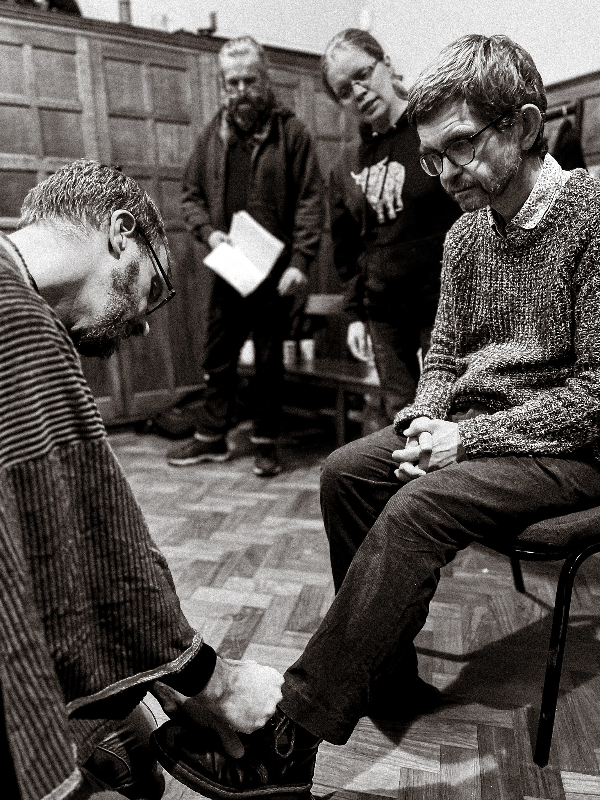
But! The serious point I was brazenly softening you up for with my disarming humour is that while pretend Jesus (me) doesn’t do feet, real Jesus absolutely does. The washing of the disciples’ feet is of huge symbolic significance. In first century Palestine, a servant wouldn’t think twice about washing the feet of their master – but a master would never wash a servant’s feet. I mean, ever. So for Jesus to wash his disciples’ feet? That’s the social order inverted, completely turned on its head.

It seems trivial today (because what’s some foot washing between friends?), but at the time it would have been shocking for Jesus’ disciples to even countenance it. There was no way they’d want Jesus to wash their feet, yet here Jesus is, doing just that anyway at the Last Supper, telling his disciples why it’s important and what this simple and humble act means.

It’s about love, plain and simple. It’s about love coming down. It’s about love transcending social order, class, convention. It’s about God as a human being, looking you in the eye, showing you care, consideration, intimacy, one to one.

And what does care, consideration, love, look like as we go out into the world and minister to others? It looks like what Jesus shows us. It looks like what he shows his best friends in all the world in Jerusalem’s Upper Room at that Last Supper and first ever communion, two thousand years ago.

And if we ever forget what it looks like, then we merely reach for some bread, and some wine, and we remember.

‘A new commandment I give you. If you love me, then love one another. And love one another as I have loved you. As I wash your feet, so you wash the feet of others.’

It echoes what Jesus says in the cleansing of the temple scene. ‘Love your neighbour as yourself.’ No exceptions to this. No carve outs. No caveats. This video explains.

It’s tough, trying to show all of this, in performance. But man! It’s such an honour.

The Last Supper is, put simply, the world turned upside down.

Everything you thought you knew about the potential in human beings for hope, for joy, for love, is eclipsed by this. The Last Supper demonstrates a new model, a new way, a new potential, for human relationships. What passes from Jesus’ lips to the ears of his closest friends over a simple meal is audacious, fearless, revolutionary. It is breathtakingly counter-cultural. And at the centre of the Last Supper? The most audacious, fearless, counter-cultural human being there has ever been.

Jesus. Teacher, leader, inspirational speaker, worker of wonders and miracles. Tenacious, outspoken opponent of religious dogma, corruption, and misuse of power.

Jesus. Defender and upholder of the poor, oppressed, and marginalised. Healer of the physically and mentally sick. A literal embodiment of God’s love.

Jesus, who saw both the conflict, and the great potential, in people. Jesus, who saw struggle, touched wounds, dried tears, showed love, washed feet. A warrior for human rights and equal opportunities and social justice before such concepts even existed.

Next stop for him in this story, though? Gethsemane.

As ever, thank you for reading.

copyright (c) carterbloke, 2023

Links – Nottingham Passion

Talk About The Passion #3 – Rage and Restraint

IF YOU’VE COME WITH ME this far and read previous instalments, you’ll know that I’m taking part in The Nottingham Passion theatre production at St Mary’s in the Lace Market this Easter. You’ll also know which role I’m playing, and that I’m finding this role to be quite the challenge.

This might sound odd, but I struggle to say the words: ‘I’ve been cast as Jesus.’

x Notts Passion Rehearsal Pic 12

I meant it when I wrote previously that being given the chance to portray Jesus was among the privileges of my life. It’s not been an easy experience so far, but with three weeks of rehearsals under my belt it feels like I’m finding my feet now. Fear and uncertainty have now given way to some self-confidence, though I worry that the Jesus voice which appears to be coming out of me sounds a bit like Russell Crowe in the movie Gladiator.

As rehearsals move into the church proper, and I stand there pretending to be him (not Russell Crowe, Jesus), and I try to articulate the utterly beautiful words he said (again not Russell Crowe, Jesus), I can’t believe it’s me who’s doing this. It doesn’t feel real yet. Maybe that’s why I struggle to say the words: ‘I’ve been cast as Jesus.’

Please don’t think these are just the outpourings of some blithering old luvvie. This is truly the way I’m feeling – and this next sentence is a simple, objective statement of fact.

Powerful stuff is happening in rehearsals right now.

Such. Powerful. Stuff.

And everyone feels it, I think. Not just me.

x Notts Passion Rehearsal Pic 16

I don’t know how to process it properly. I’ve been doing this performing arts thing for more than thirty years, and this is unlike anything I’ve ever done. I come away from rehearsals on a Tuesday and a Thursday feeling energised and exhausted, euphoric and numb, bewildered and clear-headed, filled up and empty. It feels like I don’t know what I’m doing but that I’ve never felt more ready. I’m a walking paradox.

The best I can manage right now when I speak about any of this to anyone out loud is: ‘I’ve been cast as a certain gentleman from Nazareth.’

And people go: ‘Oh. Jesus?

And I go: ‘Er. Yes.’

And people go: ‘That’s cool. How’s it going?’

And I go: ‘It’s complicated.’

Then I worry that if they read these blogs, they’ll avoid the subject next time they see me or avoid me in general, because they’ll think I’m a loony.

Oi! Keep that thought to yourself.

By way of recap, if you’ve read blog one, you’ll know all about where I am with my faith, and how being cast as Jesus has pushed me into trying to see (and show) how the events of Passion Week might have felt from the perspective of the central figure in all of it.

If you’ve read blog two, you’ll know something about what passion plays are, and read my take on how Jesus may have experienced the events of Palm Sunday, all this filtered through the lens of an honest performer seeking to tell his character’s story as truthfully as possible.

If you’ve read both blogs you’ll know that, while I’m a Christian, this series is aimed at anyone and everyone. You’ll know there are some rules of engagement too, designed to ensure that you and I make our way through this whole thing unscathed. Here are those rules again:

rule-1752536_1280

  1. I’m not going to try to answer all (any?) of life’s big questions for you, though I hope there may be something in what I’m writing which prompts you to explore some of these questions more deeply;
  2. I’m not going to preach to you – I have a faith, but this stuff is aimed at everyone, whatever their point of view;
  3. There is no pre-planned structure to this series which ends with me ‘seeing the light’ through my experience of playing Jesus. There’ll be no fluffy, gift-wrapped testimony from me at the end. That would be so twee, and perhaps a little cynical. So, to be clear. I genuinely don’t know how these pieces of writing will develop;
  4. I’m not about to get all ‘pretentious artist’ on you. I’m not that person, and I don’t do this acting lark for a living. I’m a part-time writer and performer who sincerely just wants to do the best job he can, as honestly as he can.

All of which brings us hurtling to the meat of our third instalment, which is all about ‘angry Jesus,’ or as my fellow Marvel fans might put it: ‘Jesus? Smash.’ Our focus is the scene where Jesus cleanses the temple on the Monday of Passion Week, the next main event after Palm Sunday in the chronology of that first Easter.

I’d describe the way I’m tackling this as: ‘Rage and restraint.

Hey! Would you believe it? That sounds like a paradox too. It’s almost like I set this up earlier in the blog. Let me explain the ‘rage’ bit first.

Anyone with at least a passing acquaintance of the Old Testament knows that God has ways of expressing his displeasure which are much less restrained than what the New Testament records Jesus as doing in the temple in Jerusalem on the Monday of Passion Week.

I once wrote a sketch for a comedy show called Traces Of Nuts in which Noah has a long list of creatures he hasn’t found two of for his ark yet, and decides to order them in from a catalogue to save time.

My good chums Jon Wood (as Noah) and Stephan Bessant (as catalogue Steve) make light of the watery apocalypse described in the book of Exodus here, but my basic observation is that when God gets angry in the Old Testament, he has a range of options at his disposal which go far wider than turning over some tables in a temple and forcibly ejecting some merchants and money changers.

As I’m sure you’ll know, Noah (as played in the movie Noah by Russell Crowe, who won an Oscar for Gladiator in which he might sound a bit like me when I do my Jesus voice) was only required to build an ark in the first place because God was so angry with everyone he’d decided to flood the earth and wipe out the human race. Oof.

The options available to Old Testament God therefore include the awesome power to bring about actual apocalypse (though we can chill out a bit now because of the rainbow promise) and the power to bring about at least ten horrific plagues (water turning to blood, frogs, lice, flies, livestock pestilence, boils, hail, locusts, darkness, and the killing of firstborn children) as documented in the story of Moses, also from the book of Exodus.

There is even an unofficial eleventh plague if by Joseph And The Amazing Technicolour Dreamcoat we include the event which began an entire lifetime’s output by Andrew Lloyd Webber.

Don’t ‘at’ me. I’m joking about Andrew Lloyd Webber (*1).

Put simply, you wouldn’t want to get on the wrong side of any God who could do the things we see him do in the Old Testament, or any God who could allow the bringing into being of the Andrew Lloyd Webber musical Joseph And The Amazing Technicolour Dreamcoat.

I’m obviously still joking about Andrew Lloyd Webber (*2).

Nottingham Passion poster

So, in preparing to play the character of Jesus, I have to assume that this very same God must be incarnate somewhere in the person of the apoplectic Messiah rebuking those present in Jerusalem’s temple, a man whose followers believe to have been both fully human and fully God. 

Though accounts of miracles are light on the ground during Passion Week, our passion play script shows Jesus healing the Roman guard whose ear is severed in the garden of Gethsemane, and there is (of course) the not insignificant matter of the resurrection. So, it’s clear that Jesus is a man with extraordinary, supernatural power, a man (based on what he says as he’s arrested) secure in the knowledge that God would ‘unleash all his angels’ to defend him if necessary.

And a man with a direct pipeline to such immense power could do something altogether more devastating, altogether more destructive, to those defiling the temple on the Monday of Passion Week, to those turning a house of prayer into a bandit’s cave.

But Jesus doesn’t do this, because he tempers rage with restraint.

Jesus was a human being who knew all about human emotion. He intimately understood human pain and human struggle. In common with Jesus, because we’re also human beings, you and I are capable of rage and restraint. 

A neuroscientist might tell us that when we rage, we’re unlikely to be in control of our actions because the primitive, emotionally driven and impulsive part of our brain has taken charge. There’s even a model which describes this phenomenon in a book called The Chimp Paradox by Steve Peters, which is the last paradox I’ll mention in this blog in case you get annoyed.  

When you and I show restraint, we’re more in control of what we’re doing. When we show restraint we might exercise better self-discipline. We might moderate or restrict our actions. We might even demonstrate compassion, show mercy, or practice forgiveness. None of this is easy, particularly those mercy and forgiveness parts.

Now, imagine such powerful internal conflict, but on a cosmic scale, magnified exponentially in a human being with the might and power of God inside him. What does restraint look like in such a man when he experiences the primitive, impulsive, fully human emotion of rage? The turning over of mere furniture ought to feel like getting off lightly, a miraculous escape, to anyone provoking the wrath of such a man. It could easily have been much, much worse for the merchants and the money changers.

And when the man shouting at you is the most emotionally intelligent, most insightful person to have ever walked the earth, a man who hears people at a different frequency, sees people on a different wavelength, a man who sees the potential for unity and harmony in places where others only see difference and division (see blog one where I unpack all of this), a man who realises that people simply do not know what they’re doing, who sees that people are manifestly incapable of any radical change if left to their own devices, then restraint for that man is absolutely compassion, absolutely mercy, and the pointing of those people to something else.

Something higher, something better. Something much more valuable than material wealth. Something a bit like treasure, hidden in a field.

x Notts Passion Rehearsal Pic 13

Jesus knows the people of Jerusalem can’t help themselves. It angers him greatly but he understands how they’ve arrived here. He also knows, as a prophet, how it ends for them (see blog two where I write about this). What Jesus sees in the temple breaks his heart because he knows that people, who are so beloved to him, can be better than this if only they knew, if only they realised. 

Jesus knows the people have become so gaslit, so manipulated, so corrupted by the world in which they live and the powers in charge of that world, that they no longer comprehend what truth is. In speaking truth to power, as Jesus does to those assembled in the temple, he seeks to restore power to truth. As the scene in our show progresses, something destructive gives way, through mercy and compassion, to something constructive. Jesus represents such a radical shift in how God seeks to relate to people.

In trying to consider what the events of Passion Week look like from God’s perspective, I now realise that a huge part of God’s perspective involves explicitly looking at things from our perspective – as a person walking among us.   

Jesus knows the world is broken, that people are broken, and that rage, punishment and retribution offer no route to salvation at all. The cleansing of the temple feels like a major turning point as Old Testament God gives way, through Jesus, to another, better, more relational way of dealing with people. 

While the words aren’t spoken in our production, we know from the Bible that Jesus famously says: ‘Father, forgive them, for they do not know what they are doing,’ even as he hangs on a cross, looking down on the people dividing up his clothes by casting lots. This feels like an extraordinary example of restraint to me, when surely only rage would feel appropriate.

So! All of the above to ponder in getting ready for the cleansing of the temple scene. Maybe I’m just overthinking it, and I need to be careful I don’t go all ‘method’ on you.

Too late! I’ve just thrown a table through a window (*3).

I’ll expand more on other aspects of Jesus’ character as this series develops, and we move onto the next events of Passion Week. Next up, it’s the Last Supper.

Once again, thank you very much for coming with me this far. 

(*1) = I’m not, though.

(*2) = I’m not, though.

(*3) = I didn’t really (*4).

(*4) = It was a chair.

copyright (c) carterbloke, 2023

Links – Nottingham Passion

Passion Statements

Ahead of the production of The Nottingham Passion at St Mary’s in the Lace Market at Easter 2023, we’re creating a series of short promotional videos to tell you about how things are going as we get ready to perform. This post will be updated as new videos are released.

  • Performances take place on Friday 31 March and Saturday 1 April 2023. Buy tickets for the show here.

On the Crucial Matter of Beards [Video #1 – 24/01/23]

Rehearsing the Last Supper [Video #2 – 26/01/23]

Rehearsal Talk [Video #3 – 31/01/23]

Location, Location, Location [Video #4 – 06/02/23]

No Words [Video #5 – 12/02/23]

Equal Ops [Video #6 – 21/02/23]

The Collective Effort [Video #7 – 24/02/23]

Shining Like The Sun [Video #8 – 03/03/23]

Gethsemane [Video #9 – 06/03/23]

My Father’s Scouse [Video #10 – 11/03/23]

Fight! [Video #11 – 12/03/23]

copyright (c) Nottingham Passion, 2023

Links – Nottingham Passion