Before my script came along, and I really had no idea about this when I wrote it, and I’m not sure my script even counts as ‘official,’ the last traceable Nottinghamshire Robin Hood mummers script appears to have been recorded by a chap called Dean S. Reynolds Hole in 1901. And Mr Hole’s just recording it, in a book called Then And Now, which suggests the script was probably written before 1901.
The script is here if you want to have a butcher’s. I must admit, my script includes a lot more winky jokes.
So have I really, and entirely inadvertently, written the first Nottinghamshire Robin Hood mummers script in at least 122 years? Surely I can’t claim this. Surely there must have been another one, maybe written in 1972, scribbled in a notebook by some fella called Brian or Big Ken, performed only once at Bobbers Mill, or Long Clawson, or on the bus, by the Papplewick Obby Orse Players (POOPS) to an audience of nine men and three ducks.
Surely someone remembers something Robin Hoody and mummery taking place between 1901 and 2023 in Nottinghamshire. Not just at Long Clawson. Is there a Short Clawson? Must remember to check. Surely this can’t be a massive piece of history we’re creating in Sherwood next week.
And … if I claim that my script is the first official Nottinghamshire mummers play about Robin Hood to be a) written and b) performed in this county in more than a century, will I be in trouble with the mummers mafia?
Is there a mummers mafia? Surely there can’t be a mummers mafia. Will they come out to arrest me for making lofty claims? Will I ever be seen again if they do?
Anyway. We’re on next week (Sunday 15 October) performing the Calverton Robin Hood Play. Free performances take place at 1.00 pm and 3.00 pm.
All of us here at CRAPPPS shall make no lofty claims about our script unless we are (far too easily) persuaded to drink too much and let such lofty claims blurt out, at which point the law enforcement wing of the mummers mafia will surely come out to decry us and demand we cease and desist. I imagine this law enforcement wing will be called The Cidermen.
Either way, it’s been really good knowing you, and you haven’t seen me. Right?
I WAS A STAND-UP COMIC in the 1990s. I started out in Manchester, where I was a drama degree student for three years (1993-1996), and then moved to London where I avoided starving for four years (1997-2000) by temping in offices for not much money in the daytime and telling jokes for even less money at night-time.
There were highlights and lowlights. In Manchester, after months of doing open spots, I did a great show at the Frog and Bucket with Johnny Vegas compering. On the back of that show, Johnny got the management to book me as a billed support act in my own right. This meant some proper cash and (gasp!) my name on the poster, which made me think I’d arrived.
I became a regular at the now demolished Hardy’s Well pub in Fallowfield / Rusholme, which was Manchester’s main student area. At the time it was a regular haunt of Caroline Aherne and Dave Gorman, both already established comedy names, and a then virtually unknown Lucy Porter, who I gigged with many times. Some of the best gigs of my life took place there, which made me think I’d arrived.
Down in London, my first open spot at The Comedy Store in Leicester Square went splendidly, as did my first open spot at Jongleurs in Battersea. This was back in the days before those godawful gong show style gigs became the entry level offering at the big clubs for newcomer comics like me. I did some of those gong shows. They were hideous.
But I did get the odd decent booking. I got to be on a bill with Jo Brand and Harry Hill (somewhere in Clapham, if memory serves) and a before-he-was-famous Jimmy Carr at a club in Aldgate which was called the Arts Café when I was resident compere there, and Fur Coat No Knickers when I wasn’t resident compere there anymore.
I also ran a club with my pal Steve Keyworth at Kentish Town’s Lion and Unicorn pub, which attracted headliners like Al Murray, Ross Noble and Noel Fielding, with Steve and I sharing the compering.
But London, I have to say, was mostly hell on toast for me as a comic, and the bad gigs outnumbered the good ones. I often received abuse at some awful Firkin pub in God knows where (I forget the name of the pub and which bit of the city, but let’s just call it the Frick Off and Firkin in London’s Arse End) for the dubious prospect of £30 cash in hand a week to compere. They made us do the comedy in the main pub, interrupting people who were eating. We had to shout at people all night because the radio mic never worked properly. This was very bad, and because I was the compere, I had to keep coming on to introduce other acts who’d run away and leave me to suffer alone when they’d done their time. There was very little solidarity among comics at Firkin gigs back then.
I did the Edinburgh Fringe twice. The first time was 1996, when I reached the live heats of Channel 4’s So You Think You’re Funny stand-up competition at The Gilded Balloon, having previously won the Manchester qualifier at a club run by a fella called Cuddly Dudley (true story).
Edinburgh’s Gilded Balloon clearly didn’t think I was funny after I bounded onto the stage during my heat, yanked the mic out of its stand and watched it fall apart in my hands. It was awful. I couldn’t recover from this mishap and stumbled through my act, just wanting to go home because I knew I’d blown my big chance. I had to stay in the city for two more weeks to do other shows. People would point at me (other acts mainly, which was cruel) and ask: ‘Isn’t that Broken Mic Guy?’
By 1998, when I appeared at the Edinburgh Fringe for the second time, my confidence had been shot from bombing in front of London audiences. By then, I’d discovered I was much better at writing plays and scripts for radio, so it was starting to dawn on me how much easier it would be for me to do those things instead.
The swansong gig might have been at Club Fandango in Plymouth. There’s no point asking me. Most of that period in my life I’ve deleted from my brain. But I remember that the fire alarm went off in the hotel next door to the club while I was sat in the bath, and they made me troop out into the street naked save for a towel. I had to stay in Plymouth one more night to do my show. People would point at me (other acts mainly, which was cruel) and ask: ‘Isn’t that Soggy Towel Guy?’
So, it may have been in the car home from Plymouth that I quit stand-up comedy, with no evidence to record my having been entirely inconsistent at it, with social media and YouTube not invented at the time for me to check back on now. A lucky reprieve, I think.
So that was the 1990s. In the current millennium, I have come out of retirement only once for a gig at a big club (Comedy Store in Leeds – counselling has since helped) and a few compere slots locally in Nottingham to support my mate Ash who organises comedy and cabaret events. I’ve never fully explained to Ash why I’ve tried to avoid doing actual stand-up at his comedy nights, and why I get twitchy around microphones. If he reads this he’ll finally understand, and not put me in charge of any more technical rehearsals.
I’ve never fully committed any of the above genuine traumas to writing, until now.
And I’ve pretty much avoided stand-up ever since.
Until now.
I guess there’s always been a part of me that’s wanted to lay some personal demons to rest. I’m proud of what I’ve achieved as a writer and performer since the bad old days as an occasionally adequate stand-up comic. I’ve written and performed in some critically acclaimed stuff, picked up an award or two, and had one of my plays (PHYS ED) go down a storm at Edinburgh. Queuing up to watch my actor mate Nick Osmond perform this show to a sell-out crowd at the Assembly Rooms was one especially proud moment.
But I can’t help myself. I’ve always fancied another pop at stand-up, on my terms, for old time’s sake.
There’s eight weeks of training with a professional stand-up comic, which is sweet. Boot camp with other L-plate comedians (*1) starts mid-September, with a proper gig at the end of it at Nottingham’s Pryzm venue on Sunday 12 November.
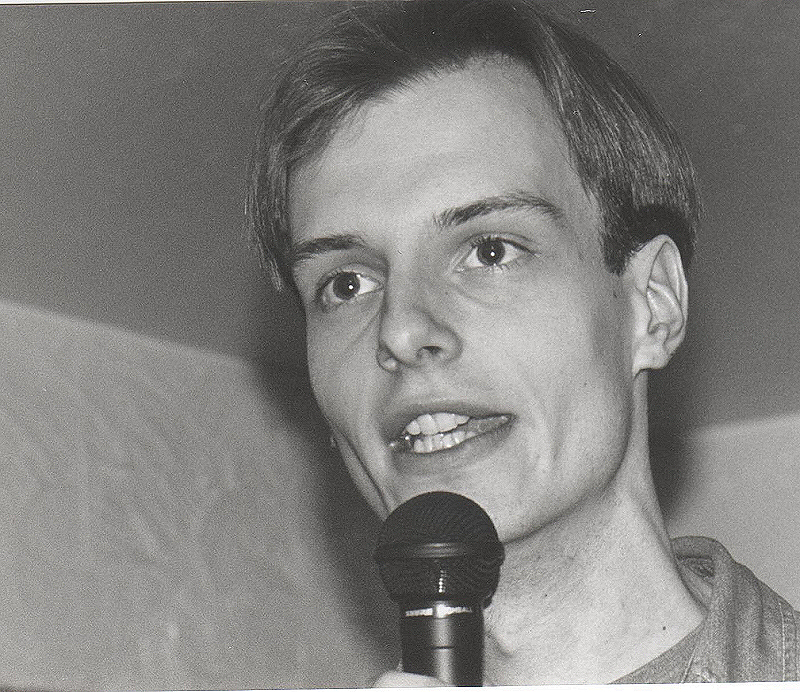
This gig will be around a week after my 50th birthday and something like 28 years since my first ever gig as the spotty student comedian in Manchester you see pictured above. I’ve just remembered my first gig was at a pub called The Thirsty Scholar. I’ve googled the pub, and it doesn’t look like it’s been demolished yet.
There was a fresh joy, a fresh delight, in each encounter. Even in a multitude, it was like Jesus could pick someone out and speak with them like they were the only one in the room. The only one who mattered.
Prophecy
Knowing about the future. Knowing all about the betrayals and the denials before the betrayers and the deniers did the betraying and denying. Jesus knew about Judas, about Peter. He knew that every other man in his inner circle would desert him. But he loved them anyway.
MORNING BREAKS as the women come to the tomb – his tomb – to find it empty. The rock at the tomb’s entrance is rolled away and the body has gone – his body. Oh!Where has his precious body gone? Who’s taken it? How could anyone have taken it? Do they not realise … do they not even care … who he was?How dare they!
In despair’s delirium, bitter tears pouring out of her once again, the woman doesn’t recognise the voice, doesn’t register who this man is kneeling beside her. Perhaps … perhaps the gardener knows what has happened.
He calls her by name.
Mary.
It’s … oh, it can’t be. It’s him.
Oh lord. It’s him.
It’s him.
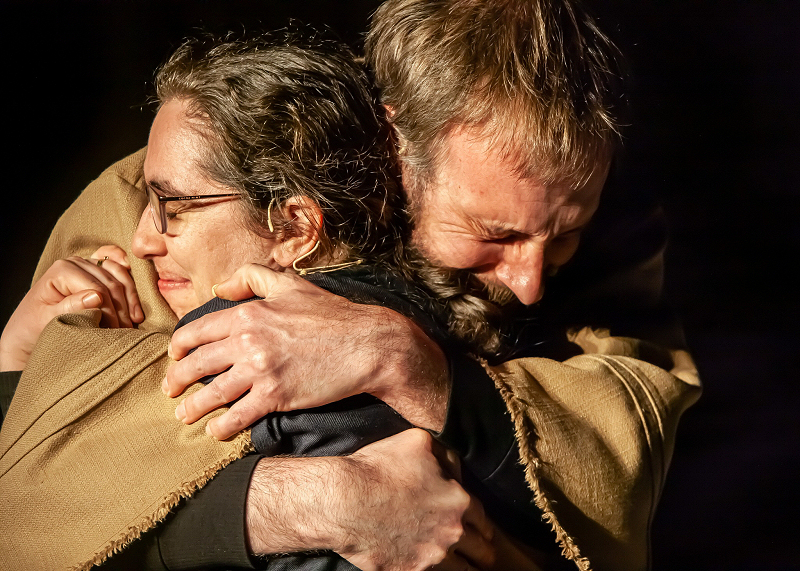
Embrace.
It’s been a week since the final performance of The Nottingham Passion at St Mary’s in the Lace Market, and I’ve found it hard to adjust to civilian life. The beard I took off on Sunday morning. It was so thick and mangled it was at least an hour in the hacking. Our friend Dawn from around the corner, Calverton’s finest mobile hairdresser, administered the smart hair cut on Tuesday, leaving me with a reflection I didn’t recognise and didn’t care to look at for a while.
Some normality began to return as the week wore on. In the end, I found myself able to talk about what I’d experienced over the past three months without wanting to break down in an immense soggy mess and cry my heart out. I couldn’t get out of my mind what we’d all just achieved.
Hundreds of people. Queuing right down the street on the Friday and the Saturday. To watch a Bible story.
Time shared with strangers, who quickly became dear friends, in this joyful, generous, hyper-focused theatre-making bubble we constructed for ourselves, has changed me. It appears to have changed other members of our company too, at least based on the words they’ve offered about their experiences on this project. I get a sense that The Nottingham Passion will not be the last hurrah for this mighty group of people and that there will be other amazing stories for us to tell. I think it’s a matter of when, rather than if. Seeds have been sown. I think that’s clear to everyone.
But it’s hard to know where we go next, having already told the mightiest story of them all, first time of asking.
We carry on, I suppose.
I think we carry on joyfully, mind you, and I’ve made a good start here, because all the pictures in this blog are in colour and everything, and not black and white like they have been in all the earlier episodes.
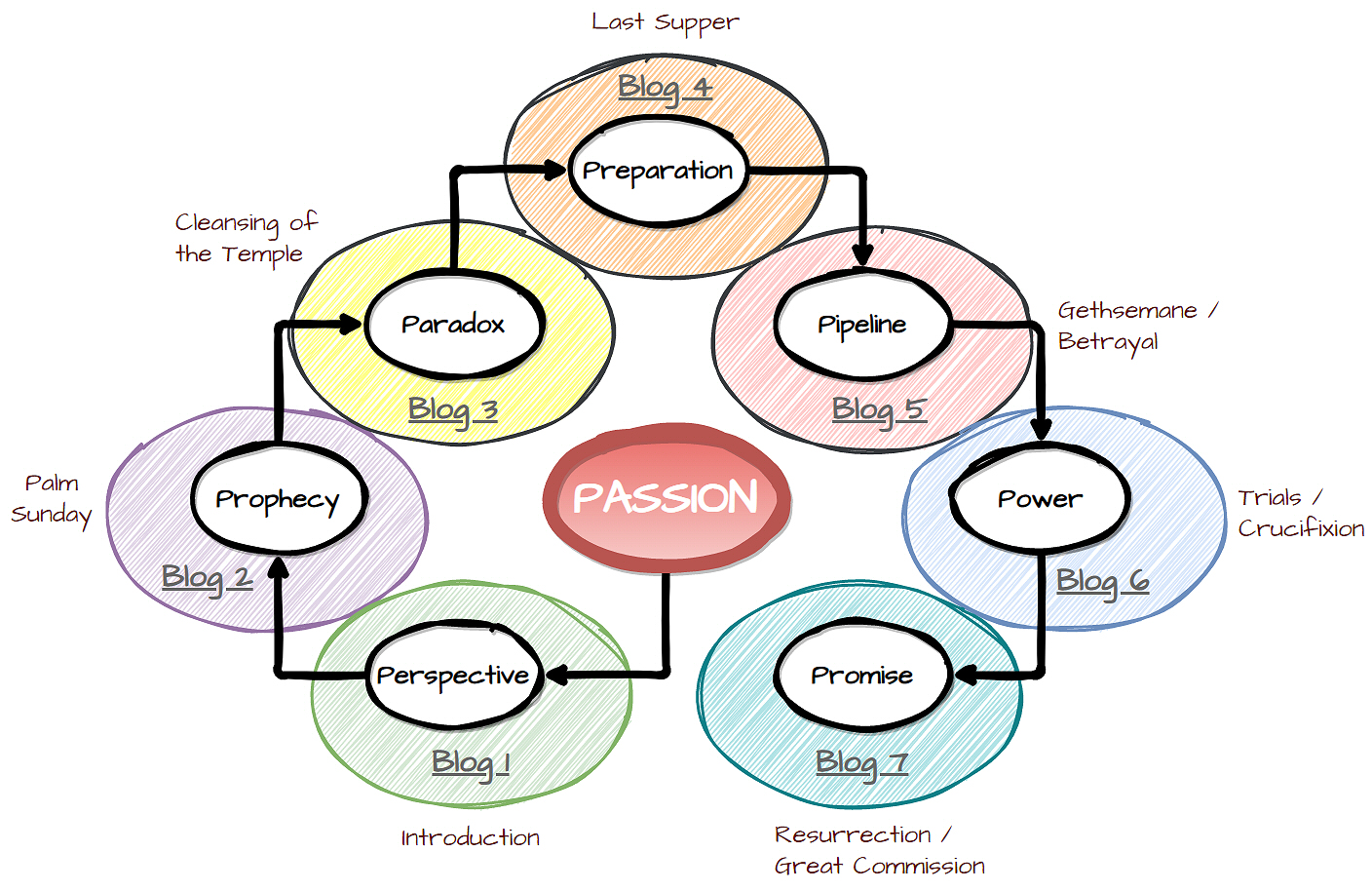
This is the closing chapter in my series of blogs about preparing to play the role of Jesus. I started writing the series in January, basing each entry around a significant event in Passion Week. I started all the way back with Palm Sunday; I’m now finishing with a piece about the resurrection and the Great Commission, with these final words being committed to paper on Easter Saturday, ahead of publication on Easter Sunday.
If you’ve followed me through this series so far, you’ll be delighted (?) to know that we’ve finally arrived at a complete set of ‘p’ words, with this, episode seven, being all about ‘promise.’
Jesus, through his words and actions, offers a promise of what is to come to those who follow. This ‘promise’ is more than a mere ‘prophecy’ of an event. When Jesus makes prophecies during Passion Week these are largely about ominous or unpropitious things, such as the destruction of Jerusalem, or his own betrayal, denial and death. It’s only when Jesus says he’ll raise a destroyed ‘temple’ in three days (he’s talking about himself, folks, not a religious building!) that we see a forecast of something brighter on the horizon. The prophecy about the temple is a resurrection prophecy. And the resurrection brings with it a promise. A promise of something so much bigger than what we can see with our own eyes. A promise of something so much bigger than the world which just rejected Jesus and put him to death.
While I think about the word ‘promise’, you’ll recall my promise to you that I wouldn’t get ‘all preachy’ (technical term) in these pieces of writing. That’s been a tough gig, and I’m sorry if you feel I’ve strayed into that territory along the way.
I meant for these blogs to be aimed at anyone and everyone, not just readers who have a faith. Throughout this series I’ve invited you to make up your own mind about who and what Jesus is, as I’ve been finding out more about him too, and I hope that at least some of what you’ve read has been helpful. It’s also my earnest hope that if you saw us perform the show last weekend it may have been a catalyst for you in deciding to find out more about the real Jesus (because I’m just a poor substitute, really). The gentleman from Nazareth may just do something extraordinary for you if you’d really like him to. I mean, don’t rule it out.
Of course, if you did want to see me talk about this stuff in sermon format, then you’re welcome to come to hear me speak at St Mary’s Church, Lowdham(9.00 am) and St Helen’s Church, Burton Joyce(11.00 am) on Sunday 30 April.
Reverend Anna Alls, Nottingham Passion legend, has asked me to come and talk to unsuspecting churchgoers all about my experiences of the past three months.
But! Performer’s perspective on Jesus for now.
This may come as a surprise, but I find that I don’t have very much to say about being resurrected (in a pretend Jesus / theatre production format, obviously). I can only speak to the relief, to the euphoria, to the sense of awe and joy, I felt each time I performed these scenes.
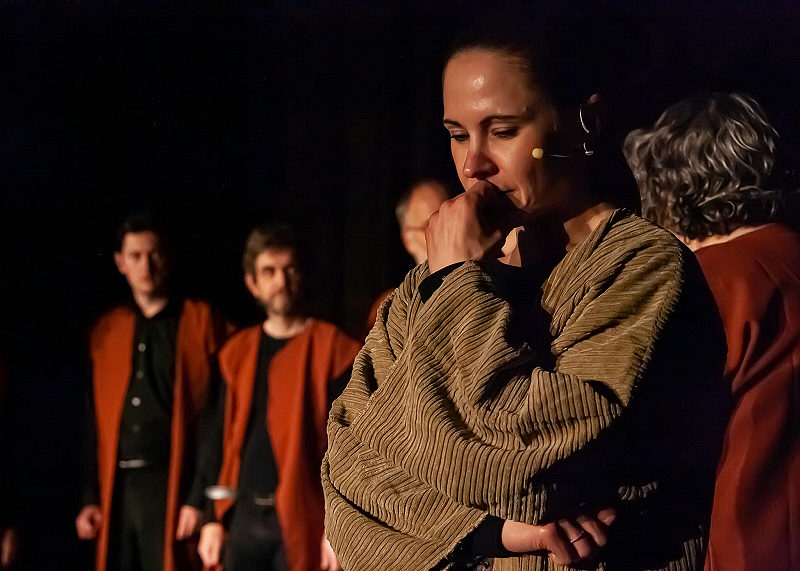
The appearance to Mary Magdalene at the empty tomb, the appearance on the road to Emmaus, the appearance to all the disciples at the show’s finale, all came with a fullness of heart, a lightness of spirit, and a sense of great thankfulness in me that I find hard to articulate. I don’t mean it to sound trite, against the background of having literally just hauled a large wooden cross down the aisle of a whopping big church, but it did feel to me in performing those final scenes that a burden had been lifted, that there was something better to come, that something was promised.
It isn’t lost on me that in the act of pretend Jesus embracing pretend Mary Magdalene at the tomb, it was really Simon embracing Rachel who works as a doctor in the same unit at Nottingham City hospital that saved my wife Jane. It was Jane falling ill in 2018 which caused my faith to suffer so terribly. That I never felt my faith completely disappear whilst crying out in fury to God during those desperate times was extraordinary to me because, surely, I ought to have turned my back on all that religious nonsense right then and there. But I never felt that I was being let go.
So, there was a beautiful symmetry in the scene with Rachel for me. It was a scene which, to me, celebrated new life in ways which weren’t solely Biblical. Believing (or not believing) in miracles is your prerogative, of course, but personally I have long since held that angels patrol the wards and corridors of our hospitals and, for what it may be worth to you, I have seen healing, restoration and rescue in my lifetime. And I’ve seen at least one enormous miracle which I shall be grateful for all my days.
I think I may have performed a genuine miracle on stage last week too. In one scene, according to one reviewer, I seem to have made the act of Judas kissing me completely invisible.
I had to put in at least one cast in-joke. Forgive me.
It’s been a privilege to play Jesus. To get a chance to show this hero of mine to other people, to try to show people a sense of who he is and what he is, to try to encourage people to want to get to know him better. Also, to be part of a beautiful and powerful interpretation of a story which doesn’t major on the blood and the suffering. Wow.
We don’t have to show the visceral to be moved by the power of it. Of course Jesus suffered, but he suffered his whole life. His suffering for people was so much bigger, so much broader, than the bloody event which ultimately killed him. Jesus suffered long and hard before he ascended that hill to be crucified. We tend to tune out the mental suffering Jesus endured when we think of Passion Week. The fatigue, the doubt, the desperation, the absolute, unrelenting pressure of being who he was. All of these things we’ve tried to bring to bear in this production.
We’ve also tried to bring out the sense of delight in Jesus and the adoration he had for people. The way Jesus was with children. The way he sees into a person’s soul like they’re the only one in the room. The way he knows them, and sees them, and thinks they’re so beautiful, despite everything. That’s the sense I’ve had of the man I first read about in a storybook when I was a boy in pyjamas with the sun streaming through the window.
To me, Jesus is so much more than the mangled thing they made of him on the cross and it’s been my joy and honour to try to bring him back to life for people, all over again.
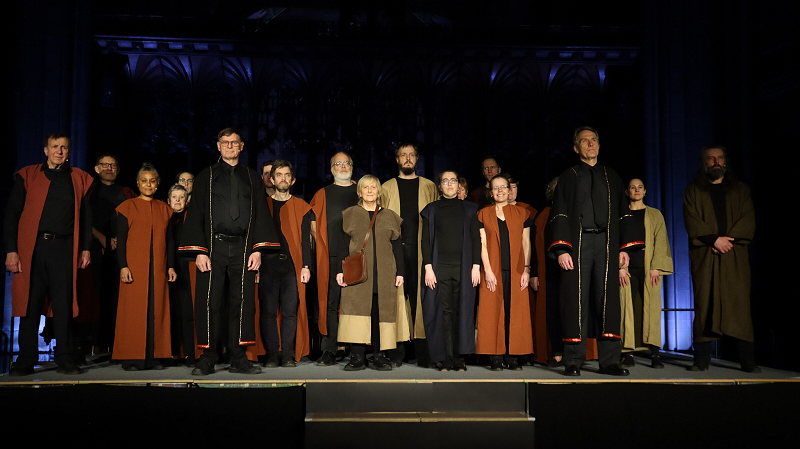
I’m giving over the rest of this blog to the glorious people who shared this experience with me. My voice isn’t the only voice in this story. The voices of my friends from across the company of The Nottingham Passion are every bit as powerful.
Thank you to them. Thank you to Reverend James Pacey, who helmed this project so wonderfully.
And thank you, for reading this series. Thank you for being with me, to the very end.
It is finished.
copyright (c) carterbloke / company of The Nottingham Passion, 2023









 Simon Carter
You must be logged in to post a comment.