Before my script came along, and I really had no idea about this when I wrote it, and I’m not sure my script even counts as ‘official,’ the last traceable Nottinghamshire Robin Hood mummers script appears to have been recorded by a chap called Dean S. Reynolds Hole in 1901. And Mr Hole’s just recording it, in a book called Then And Now, which suggests the script was probably written before 1901.
The script is here if you want to have a butcher’s. I must admit, my script includes a lot more winky jokes.
So have I really, and entirely inadvertently, written the first Nottinghamshire Robin Hood mummers script in at least 122 years? Surely I can’t claim this. Surely there must have been another one, maybe written in 1972, scribbled in a notebook by some fella called Brian or Big Ken, performed only once at Bobbers Mill, or Long Clawson, or on the bus, by the Papplewick Obby Orse Players (POOPS) to an audience of nine men and three ducks.
Surely someone remembers something Robin Hoody and mummery taking place between 1901 and 2023 in Nottinghamshire. Not just at Long Clawson. Is there a Short Clawson? Must remember to check. Surely this can’t be a massive piece of history we’re creating in Sherwood next week.
And … if I claim that my script is the first official Nottinghamshire mummers play about Robin Hood to be a) written and b) performed in this county in more than a century, will I be in trouble with the mummers mafia?
Is there a mummers mafia? Surely there can’t be a mummers mafia. Will they come out to arrest me for making lofty claims? Will I ever be seen again if they do?
Anyway. We’re on next week (Sunday 15 October) performing the Calverton Robin Hood Play. Free performances take place at 1.00 pm and 3.00 pm.
All of us here at CRAPPPS shall make no lofty claims about our script unless we are (far too easily) persuaded to drink too much and let such lofty claims blurt out, at which point the law enforcement wing of the mummers mafia will surely come out to decry us and demand we cease and desist. I imagine this law enforcement wing will be called The Cidermen.
Either way, it’s been really good knowing you, and you haven’t seen me. Right?
There was a fresh joy, a fresh delight, in each encounter. Even in a multitude, it was like Jesus could pick someone out and speak with them like they were the only one in the room. The only one who mattered.
Prophecy
Knowing about the future. Knowing all about the betrayals and the denials before the betrayers and the deniers did the betraying and denying. Jesus knew about Judas, about Peter. He knew that every other man in his inner circle would desert him. But he loved them anyway.
MORNING BREAKS as the women come to the tomb – his tomb – to find it empty. The rock at the tomb’s entrance is rolled away and the body has gone – his body. Oh!Where has his precious body gone? Who’s taken it? How could anyone have taken it? Do they not realise … do they not even care … who he was?How dare they!
In despair’s delirium, bitter tears pouring out of her once again, the woman doesn’t recognise the voice, doesn’t register who this man is kneeling beside her. Perhaps … perhaps the gardener knows what has happened.
He calls her by name.
Mary.
It’s … oh, it can’t be. It’s him.
Oh lord. It’s him.
It’s him.
Embrace.
It’s been a week since the final performance of The Nottingham Passion at St Mary’s in the Lace Market, and I’ve found it hard to adjust to civilian life. The beard I took off on Sunday morning. It was so thick and mangled it was at least an hour in the hacking. Our friend Dawn from around the corner, Calverton’s finest mobile hairdresser, administered the smart hair cut on Tuesday, leaving me with a reflection I didn’t recognise and didn’t care to look at for a while.
Some normality began to return as the week wore on. In the end, I found myself able to talk about what I’d experienced over the past three months without wanting to break down in an immense soggy mess and cry my heart out. I couldn’t get out of my mind what we’d all just achieved.
Hundreds of people. Queuing right down the street on the Friday and the Saturday. To watch a Bible story.
Time shared with strangers, who quickly became dear friends, in this joyful, generous, hyper-focused theatre-making bubble we constructed for ourselves, has changed me. It appears to have changed other members of our company too, at least based on the words they’ve offered about their experiences on this project. I get a sense that The Nottingham Passion will not be the last hurrah for this mighty group of people and that there will be other amazing stories for us to tell. I think it’s a matter of when, rather than if. Seeds have been sown. I think that’s clear to everyone.
But it’s hard to know where we go next, having already told the mightiest story of them all, first time of asking.
We carry on, I suppose.
I think we carry on joyfully, mind you, and I’ve made a good start here, because all the pictures in this blog are in colour and everything, and not black and white like they have been in all the earlier episodes.
This is the closing chapter in my series of blogs about preparing to play the role of Jesus. I started writing the series in January, basing each entry around a significant event in Passion Week. I started all the way back with Palm Sunday; I’m now finishing with a piece about the resurrection and the Great Commission, with these final words being committed to paper on Easter Saturday, ahead of publication on Easter Sunday.
If you’ve followed me through this series so far, you’ll be delighted (?) to know that we’ve finally arrived at a complete set of ‘p’ words, with this, episode seven, being all about ‘promise.’
Jesus, through his words and actions, offers a promise of what is to come to those who follow. This ‘promise’ is more than a mere ‘prophecy’ of an event. When Jesus makes prophecies during Passion Week these are largely about ominous or unpropitious things, such as the destruction of Jerusalem, or his own betrayal, denial and death. It’s only when Jesus says he’ll raise a destroyed ‘temple’ in three days (he’s talking about himself, folks, not a religious building!) that we see a forecast of something brighter on the horizon. The prophecy about the temple is a resurrection prophecy. And the resurrection brings with it a promise. A promise of something so much bigger than what we can see with our own eyes. A promise of something so much bigger than the world which just rejected Jesus and put him to death.
While I think about the word ‘promise’, you’ll recall my promise to you that I wouldn’t get ‘all preachy’ (technical term) in these pieces of writing. That’s been a tough gig, and I’m sorry if you feel I’ve strayed into that territory along the way.
I meant for these blogs to be aimed at anyone and everyone, not just readers who have a faith. Throughout this series I’ve invited you to make up your own mind about who and what Jesus is, as I’ve been finding out more about him too, and I hope that at least some of what you’ve read has been helpful. It’s also my earnest hope that if you saw us perform the show last weekend it may have been a catalyst for you in deciding to find out more about the real Jesus (because I’m just a poor substitute, really). The gentleman from Nazareth may just do something extraordinary for you if you’d really like him to. I mean, don’t rule it out.
Of course, if you did want to see me talk about this stuff in sermon format, then you’re welcome to come to hear me speak at St Mary’s Church, Lowdham(9.00 am) and St Helen’s Church, Burton Joyce(11.00 am) on Sunday 30 April.
Reverend Anna Alls, Nottingham Passion legend, has asked me to come and talk to unsuspecting churchgoers all about my experiences of the past three months.
But! Performer’s perspective on Jesus for now.
This may come as a surprise, but I find that I don’t have very much to say about being resurrected (in a pretend Jesus / theatre production format, obviously). I can only speak to the relief, to the euphoria, to the sense of awe and joy, I felt each time I performed these scenes.
The appearance to Mary Magdalene at the empty tomb, the appearance on the road to Emmaus, the appearance to all the disciples at the show’s finale, all came with a fullness of heart, a lightness of spirit, and a sense of great thankfulness in me that I find hard to articulate. I don’t mean it to sound trite, against the background of having literally just hauled a large wooden cross down the aisle of a whopping big church, but it did feel to me in performing those final scenes that a burden had been lifted, that there was something better to come, that something was promised.
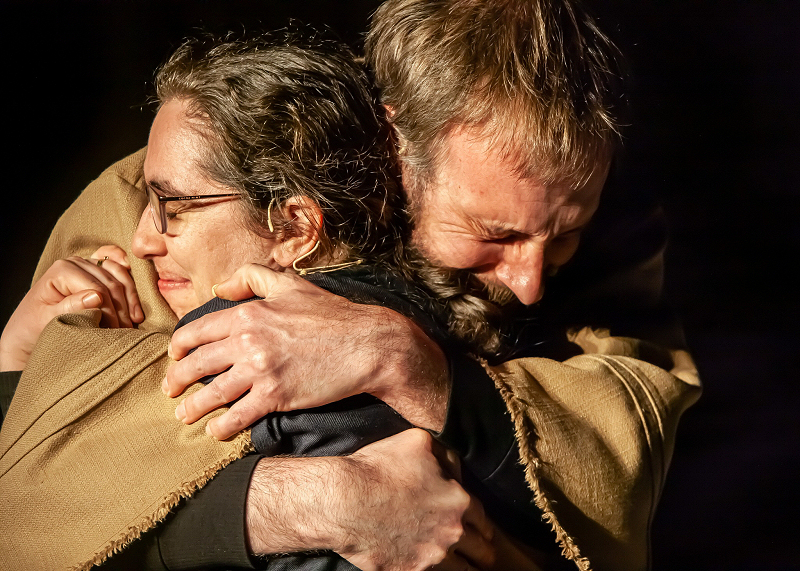
It isn’t lost on me that in the act of pretend Jesus embracing pretend Mary Magdalene at the tomb, it was really Simon embracing Rachel who works as a doctor in the same unit at Nottingham City hospital that saved my wife Jane. It was Jane falling ill in 2018 which caused my faith to suffer so terribly. That I never felt my faith completely disappear whilst crying out in fury to God during those desperate times was extraordinary to me because, surely, I ought to have turned my back on all that religious nonsense right then and there. But I never felt that I was being let go.
So, there was a beautiful symmetry in the scene with Rachel for me. It was a scene which, to me, celebrated new life in ways which weren’t solely Biblical. Believing (or not believing) in miracles is your prerogative, of course, but personally I have long since held that angels patrol the wards and corridors of our hospitals and, for what it may be worth to you, I have seen healing, restoration and rescue in my lifetime. And I’ve seen at least one enormous miracle which I shall be grateful for all my days.
I think I may have performed a genuine miracle on stage last week too. In one scene, according to one reviewer, I seem to have made the act of Judas kissing me completely invisible.
I had to put in at least one cast in-joke. Forgive me.
It’s been a privilege to play Jesus. To get a chance to show this hero of mine to other people, to try to show people a sense of who he is and what he is, to try to encourage people to want to get to know him better. Also, to be part of a beautiful and powerful interpretation of a story which doesn’t major on the blood and the suffering. Wow.
We don’t have to show the visceral to be moved by the power of it. Of course Jesus suffered, but he suffered his whole life. His suffering for people was so much bigger, so much broader, than the bloody event which ultimately killed him. Jesus suffered long and hard before he ascended that hill to be crucified. We tend to tune out the mental suffering Jesus endured when we think of Passion Week. The fatigue, the doubt, the desperation, the absolute, unrelenting pressure of being who he was. All of these things we’ve tried to bring to bear in this production.
We’ve also tried to bring out the sense of delight in Jesus and the adoration he had for people. The way Jesus was with children. The way he sees into a person’s soul like they’re the only one in the room. The way he knows them, and sees them, and thinks they’re so beautiful, despite everything. That’s the sense I’ve had of the man I first read about in a storybook when I was a boy in pyjamas with the sun streaming through the window.
To me, Jesus is so much more than the mangled thing they made of him on the cross and it’s been my joy and honour to try to bring him back to life for people, all over again.
I’m giving over the rest of this blog to the glorious people who shared this experience with me. My voice isn’t the only voice in this story. The voices of my friends from across the company of The Nottingham Passion are every bit as powerful.
Thank you to them. Thank you to Reverend James Pacey, who helmed this project so wonderfully.
And thank you, for reading this series. Thank you for being with me, to the very end.
It is finished.
copyright (c) carterbloke / company of The Nottingham Passion, 2023
IT’S GOING TO BE INTENSE. I write this at the beginning of production week for The Nottingham Passion at St Mary’s in the Lace Market,a wonderful and powerful new theatrical interpretation of the Passion Week story written and directed by Reverend James Pacey(with help, as I understand it, from some other people called Matthew, Mark, Luke, and John).
Work on this project began, of course, much earlier for James and his team of organisers,but for me it started with a somewhatnervy audition at Nottingham Playhouse in November last yearandmy being cast in the role of Jesus.
If you’ve followed the whole series of blogs from the beginning, you’ll know how my faith has been (and continues to be) a struggle and how, as I’ve gone through tough times, there have been long phases where I’ve questioned how there can be a loving God when there is so much suffering everywhere.If there is a loving God who has a ‘greater plan,’ how can this plan possibly be served by the seemingly inexplicable suffering of innocentsalongside the rise and prospering of real evil in this world? I know I’m not alone in asking these, or similar, questions.
I’ve explained that my perspective has often been that of a frustrated human being remonstrating with God about how he could surely make all the bad things go away, and how he doesn’t seem to do that. I’ve explained how taking on the role of Jesus has pushed me to try to look more carefully at what God’s perspective on this might be.
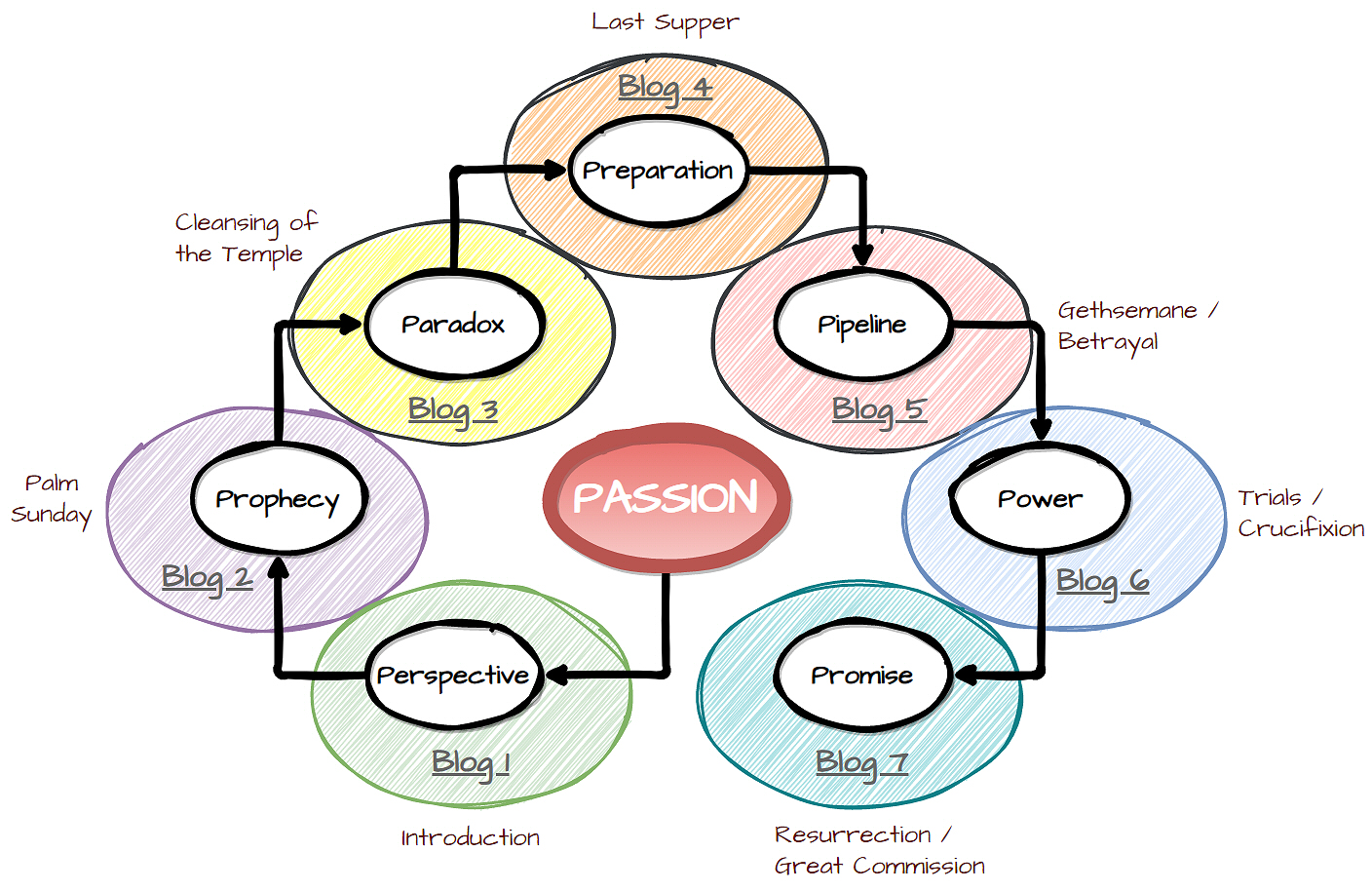
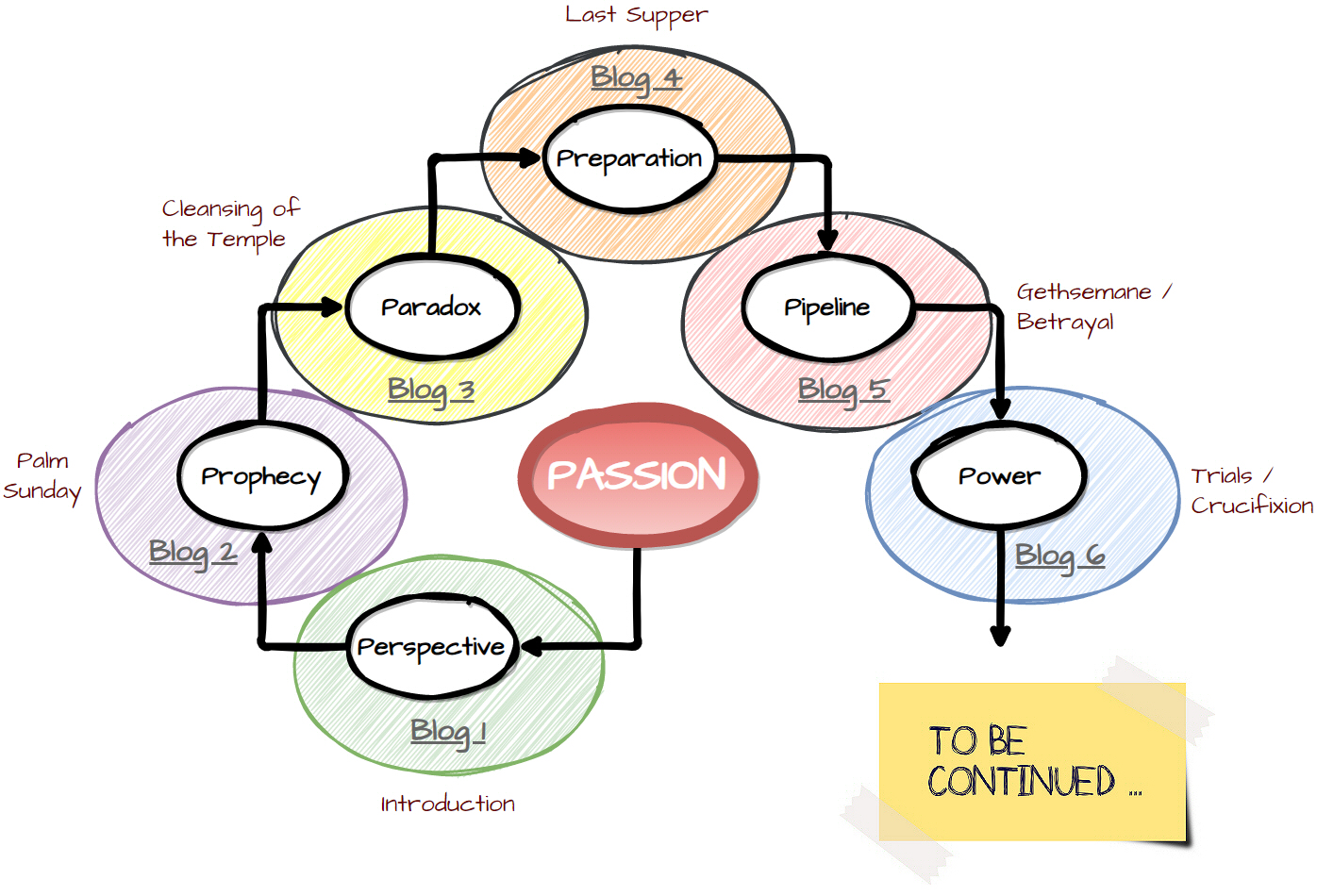
So far in this series, with deployment of some carefully chosen ‘p’ words, I’ve written about:
Jesus’ pipeline to God and what happens when Jesus is made to feel abandonment (in the context of Gethsemane – blog five).
Welcome then to blog six, in which we consider the trials and crucifixion of Jesus and how in Passion Week, against a backdrop of betrayal, conspiracy and corruption, Jesus seeks to demonstrate to powerful people (through his willing sacrificial suffering for others) what absolutepower truly is.
For those of you who prefer the visuals, here’s the story so far in a really quite groovy diagrammatic format.
Oh! Also! Let’s not forget those rules of engagement which have helped me (probably more so than you if I’m honest) to navigate my way through this series.
I’m not going to try to answer all (any?) of life’s big questions for you, though I hope there may be something in what I’m writing which prompts you to explore some of these questions more deeply;
I’m not going to preach to you – I have a faith, but this stuff is aimed at everyone, whatever their point of view;
There is no pre-planned structure to this series which ends with me ‘seeing the light’ through my experience of playing Jesus. There’ll be no fluffy, gift-wrapped testimony from me at the end. That would be so twee, and perhaps a little cynical. So, to be clear. I genuinely don’t know how these pieces of writing will develop;
I’m not about to get all ‘pretentious artist’ on you. I’m not that person, and I don’t do this acting lark for a living. I’m a part-time writer and performer who sincerely just wants to do the best job he can, as honestly as he can.
The mental and spiritual agony endured by Jesus in Gethsemane (see blog five) leads, inevitably, to the punishing physical agony of his trials at the hands of the Sanhedrin and Pontius Pilate and, ultimately, his crucifixion. While the stylised nature of our production doesn’t show in graphic detail the torment and torture that Jesus undergoes, it doesn’t shy away from communicating the stark brutality of the suffering he endures. It’s so desperately sad to see what this innocent man is made to go through. It’s raw, it’s horrifying, and it’s upsetting.
It’s not the purpose of this series to dwell on the complex theology of what the cross represents, and the power of what this man strove to achieve for humanity on Calvary hill on that longest and darkest of nights some two thousand years ago. The purposeis to try to imaginethe events of Passion Week from the perspective of Jesusand communicate what it’s like to try to bring that over in performance.
Whether you believe Jesus to have been the son of God, or merely a man, there is little doubt that Jesus hada profound and compellingreason for doing what he did. Jesusappears to have made a deliberate decision to die for everyone,irrespective of how we feel about that and whether or not we wanted him to.His was an act not only of astonishing compassion, but wilful substitution.In simple theological terms, the core message of the gospelis that Jesus takes on accountability for the garbage and mess of all humanity, on humanity’s behalf, so that things are made right between people and God.In our show, we see this signposted in the unspoken exchange between Jesus and Barabbas, unpacked in this video.
There are two aspects of Jesus’ character I’ve been considering while preparing to perform the trials and crucifixion scenes – these are ‘father’s heart’ and ‘total accountability.’
My Christian friend Stuart once told me I had a‘father’s heart,’ which (derived from some verses in John’s gospel) essentially means having a love-filled heart, with room in it for everyone. If this is true (and I’m not sure, because there are some things which Iplainly don’t have a love-filled heart for such as iceberg lettuce, and the musical output of Coldplay) this is a real blessing. But I also think it can be something of a curse. The Christian writer Lewis B. Smedescautions those with afather’s heart about its flip side,the wearyingburden of what he describes as ‘total accountability.’
‘Some of us,’ says Smedes,‘nurture an illusion that we are accountable for all the ills of the world. In our silly pride, we are stupid enough to suppose that God expects us to carry on our little backs a load that only Jesus can bear.(Total accountability) besets sensitive and moral people. … The more sensitive you are to other people’s troubles and your own responsibility, the more vulnerable you are.’
This speaks to me hugely. Maybe it does to you. I would never want to stoplistening to peopleabout their problems and trying to help them if I can.As Chris Martin famously sings: ‘I will try to fix you,’ even though it’s simply not possible to fixthe great majority ofColdplaysongs. The desire to want to help people feels innate and instinctive to me, but as many well-meaning friends, family and workmates have told me so often in the past, I can’t help anyone if I’m a shipwreck, and that means having to put myself first sometimes.
No mere mortal can carry the weight of the world on their shoulders.No-oneperson can help everyone. No-oneperson can save everyone.But I’ve had the rare honour and privilege towalk a little in the shoes of someone who I’m increasingly beginning to believe can do each of those things.
To be clear, it’s not like Jesus didn’t do self-care.Accounts of himtaking time away to be alone, to pray, to rest, to replenish, are there in the gospels.Jesus’ ministry necessarily came with downtime, becausebeing fully human came with the risk of being fully exhausted if he didn’t take opportunity for pause. Even Jesus was at risk of burnout.It’s reasonable to assume, therefore, that there were occasions when (whisper this) he needed to put his own wellbeing first so that he could then best attend to the wellbeing of others.
In attending to the wellbeing of others, though, the difference between Jesus and mere mortals comessquarely in that ‘total accountability’ I speak of.
‘Total accountability,’ it seems, becoming ‘accountable for all the ills of the world’ as Smedes describes it, is a load that only Jesusis equipped to bear.The physical weight of the cross which Jesus carries is symbolic of theinfinitely heavier weight he carries inbearing the sins of humanity on his shoulders and dying so that ‘all the world shall find salvation and forgiveness’(checksown lines from Gethsemane scene – correct!).
We’re not built to bear such a load, and we shouldn’t pretend to be, no matter how well-meaning we are, no matter how genuine and honourable our intentions.
But what does all this mean in performance terms? What’s going through my mind as I’m getting ready to act it all out this week?
Let’s start with a tenuous boxing metaphor (or a wrestling one if you prefer spandex). In the blue corner stand the Sanhedrin (Jerusalem’s religious authorities) and Pontius Pilate (governor of the Roman province of Judaea), there to put Jesus on trial for his supposed blasphemies and to pass sentence. In the red corner stands Jesus –itinerant rabbi, champion of the last, least and lost, speaker of uncomfortable truths, worker of miracles, signs, and wonders.
Who’s your money on here, folks? Who has the power? This doesn’t seem like a fair fight, at least on parchment.
Is Jesus powerful or powerless?
As an ordinary human being trying to act this stuff out, it can feel like both of these at once when I’m in the middle of it. I don’t have very many lines to speak in the trial scene with the Sanhedrin or the scene where Jesus is interrogated by Pilate, but I’m there onstage. It puts me in the somewhat unusual position where I can be an observer of the scenes as much as a participant in them.
It feels like the walls are closing in when I do the trial scenes. It’s such an appalling sequence of events. The things they put that innocent man through. In strictly human terms, Jesus has no power at all here. He’s isolated. He’s fearful. It’s ruthless, relentless, what they’re doing to him. He’s being abused. Brutalised. He’s taking it all, and presumably he doesn’t have to, given that he’s told his disciples that if he willed it, God would unleash actual angels to defend him. Jesus stands down the angels, relieves them of their service, endures the cruelty.
A man with a God within him who we know from Old Testament accounts is able to destroy and destroy utterly. There is such power in Jesus’ restraint when surely rage would seem the most appropriate human response. And Jesus takes the punishment anyway, when it should be Barabbas, when it should be someone else, anyone, everyone, but him. I’m pretty much shaken to my core before the cross even arrives at the crucifixion scene.
And then there’s the crucifixion scene. It’s impossible for me to know what it looks like to an audience because I’m in the midst of it, but it feels so, so very sad every time I do it. I think the scene has a unique beauty and a power all of its own, and it will affect different people in different ways. For me, as a person with a faith, the only words which appear in any way appropriate when it comes to speaking with Jesus about re-enacting this sequence of events are: ‘thank you.’
From an ordinary human being perspective on power, then, to a fully human / fully God perspective on power. This other perspective is explained in Jesus’ few, but extraordinary, words to Pontius Pilate – Pilate, with all of the power he thinks he has.
‘You would have no power over me,’ says Jesus, ‘unless it had been given to you from above. I was born, and I came into this world, to testify to the truth.’
Pilate asks Jesus what truth is, unaware it’s looking right at him. Right at him.
It’s not the first time our show examines the issue of power. Nicodemus, the Pharisee, seems to get Jesus, and the power that is in him, right from the start. In an early scene, Nicodemus says to his fellow Sanhedrin members: ‘How right Jesus is about us. Power and status are difficult things to let go.’
Nicodemus sees a bigger picture that his counterparts cannot see, sees true power as something so much bigger than earthly power, bigger than status, bigger than control and enforced conformity, bigger than privilege, bigger than human-made law itself. Nicodemus senses in Jesus a complete redefining of power, an embodiment of true power, with love for God and love for each other at the heart and mind and soul of all of it – a power that is beautiful, pure, incorrupt and incorruptible, no matter what cowards, tyrants and monsters would do to thwart it. It’s a power, an absolute power, that will endure down the ages.
I’m fond of what Lord Acton famously said to Bishop Creighton about power, even though he has it only half right in my view.
In Jesus’ eyes, power tends to corrupt. But absolute power conquers absolutely.
To finish, my friend Mark suggested to me at the beginning of this project that the experience of playing Jesus would change me. I think he was right. It’s been a series of incremental changes rather than huge epiphanies, but there have been changes nonetheless. Portraying Jesus of Nazareth has been quite the task for Simon of Calverton. I still don’t have answers for any of life’s big questions (I don’t think that was ever a realistic outcome to expect from this) but what I’ve learned, and am still learning as I go, has helped me. I’ve become less frustrated these past weeks and months, less exasperated, more level-headed, more patient. Life is a longer game, and the world’s problems do not have quick fixes.
Ten years since I was baptised now, and maybe this is me accepting that no one person can solve all the world’s problems on their own, or reasonably be expected to try. Maybe this is me being kinder to myself and accepting that anger at the state of the world, and the raging at the machine, shouldn’t be at the heart of a person to the exclusion of everything else.
Anger, unchecked, can become all-consuming. It can diminish our hope, steal our joy, make us part of the problem rather than part of the solution. We can grieve at the almighty mess we’ve made of the world; we can strive to make a change through positive action and activism (because faith without action is dead), but anger achieves little in the end though it may be where any change worth making starts. Even God himself realised this, when he came down to earth in the form of a man called Jesus and found out first-hand what it was like for us – Old Testament God giving way, through Jesus, to another, better, more relational way of dealing with people.
Hey. Maybe this is me accepting my limitations and working out what grace is. Maybe this is me growing up. Shh! Don’t tell my friends.
This blog takes us all the way into the public performances of The Nottingham Passion on Friday 31 March and Saturday 1 April. Tickets for both performances have long since sold out, but you can apply for any returned tickets by sending an email to nottinghampassion@gmail.com.
Next week, after the performances have finished (and I’ve had a long overdue haircut and shave) my plan is to conclude this series by writing about the resurrection and Great Commission scenes which comprise our show’s finale and offering some final retrospective thoughts about how everything went for Team Nottingham Passion during production week.
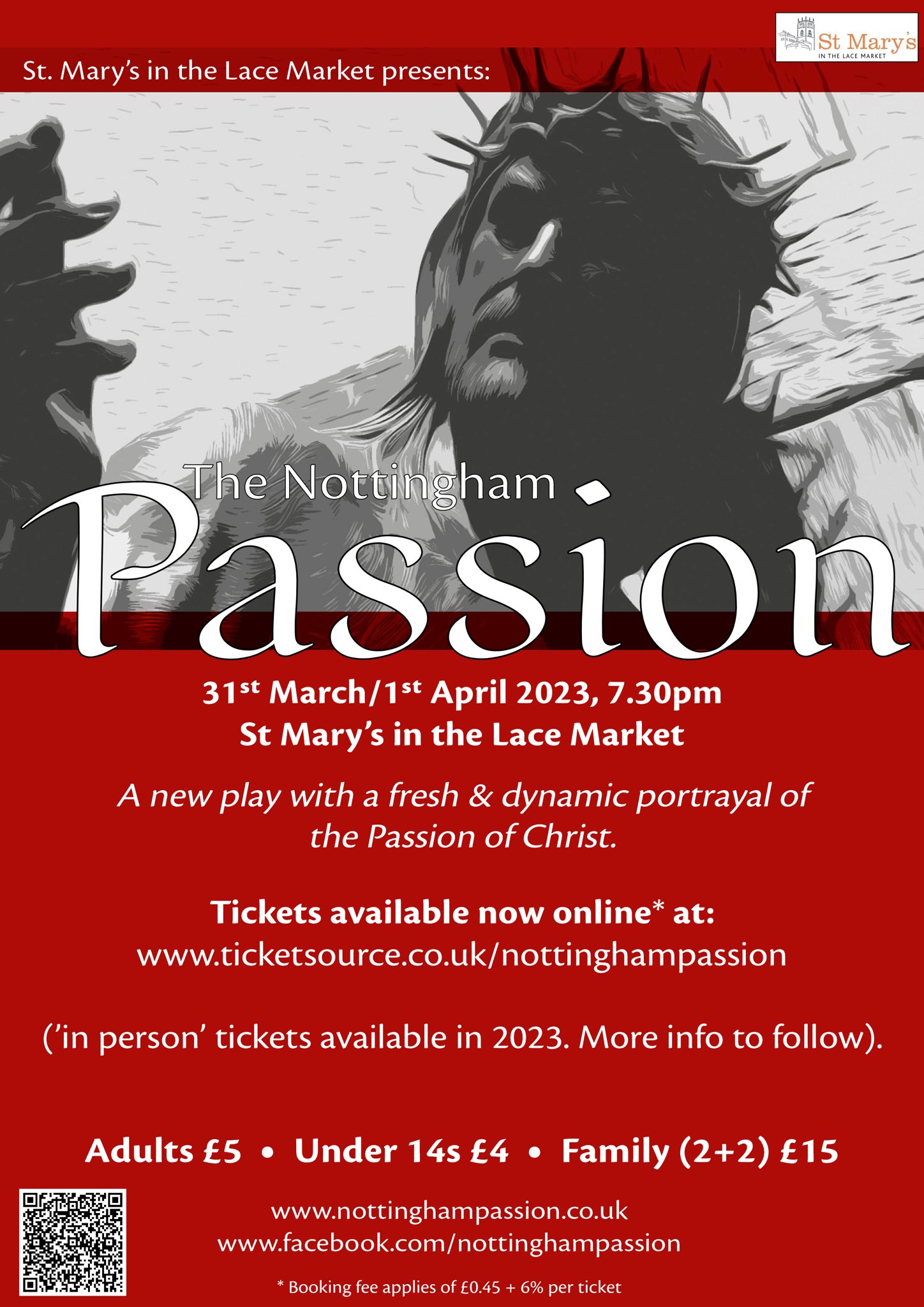
I’M PLAYING JESUS in The Nottingham Passion at St Mary’s in the Lace Market this Easter. ‘This Easter’ is imminent, of course, and our company will soon be unveiling its interpretation of the Passion Week story in a wonderful and powerful new theatre production written and directed by Reverend James Pacey.
Followers of this series of blogs will know that I’ve been getting to grips with the various challenges of getting ready to portray Jesus and have been writing some performer’s reflections on these throughout the rehearsal process.
Welcome then to blog five, in which we consider the agony, betrayal and arrest of Jesus in the garden of Gethsemane and the abandonment Jesus is made to feel – not just the physical abandonment by his disciples, who will scatter and flee from him in disarray, but spiritual abandonment by God. Yes. You read that last bit correctly.
As ever, there are rules of engagement for readers who may be wondering (or have just forgotten, admit it!) why I’m writing this series. You can find these rules, perhaps unsurprisingly, under the picture below which says: ‘Rules.’
Told you!
I’m not going to try to answer all (any?) of life’s big questions for you, though I hope there may be something in what I’m writing which prompts you to explore some of these questions more deeply;
I’m not going to preach to you – I have a faith, but this stuff is aimed at everyone, whatever their point of view;
There is no pre-planned structure to this series which ends with me ‘seeing the light’ through my experience of playing Jesus. There’ll be no fluffy, gift-wrapped testimony from me at the end. That would be so twee, and perhaps a little cynical. So, to be clear. I genuinely don’t know how these pieces of writing will develop;
I’m not about to get all ‘pretentious artist’ on you. I’m not that person, and I don’t do this acting lark for a living. I’m a part-time writer and performer who sincerely just wants to do the best job he can, as honestly as he can.
You won’t be surprised to learn (if you’ve been with me to this point) that I’ve been developing a bit of a thing for ‘p’ words. Perspective? Prophecy? Paradox? Preparation? These are all well and good, but how about pipeline for blog five? By this I mean Jesus’ connection to God. I mean Jesus’ driving force – his source of spirit, light, power, inspiration, replenishment, solace, everything. What happens when that’s taken away from Jesus? What happens to the son of God when he feels that God has gone? What must that agony be like? And how do you try to represent it in performance?
I’m getting better with this new diagramming software, by the way.
At Gethsemane, for the first time in Jesus’ human life, he experiences what it’s like to feel total abandonment and isolation. What happens to Jesus in the garden is terrifying, and in enduring it, he becomes more complete a human than he has ever been. In his abandonment Jesus comes to know true fragility, true vulnerability, true heartbreak, true isolation, true fear and (whisper this), true doubt. True, pure, raw, humanity. The gospel writer Luke records that Jesus: ‘being in anguish … prayed more earnestly, and his sweat was like drops of blood falling to the ground.’
This chapter in our story is not so much Passion Week as Passion Bleak. Gethsemane, put simply, is darkness. It’s desolation. It’s torment. If the trials and the crucifixion show Jesus in the extremes of physical agony, Gethsemane is Jesus in the extremes of mental and spiritual agony. It’s unrelenting, visceral, excruciating. And it’s the point of no return for Jesus. It’s here in the garden that any ordinary human being, any lesser mortal, might well have capitulated to the sheer, naked terror of all of it and fled for their life.
But Jesus is no ordinary human, and chooses differently.
Once betrayed, once arrested, once in Roman clutches, Jesus knows there will be no turning back. Once the events of Gethsemane play out as predicted, Jesus, alone, incarcerated and left to his fate by his disciples, will find himself on a trajectory that leads to trial, humiliation, torture and death. From Gethsemane, this can go only one way for Jesus.
How remarkable, then, that he does it anyway.
I’ll admit that I’ve had some real worries about doing the ‘let this cup pass from me’ monologue in the Gethsemane scene. More so than the crucifixion scene (where my most acute fear is accidentally braining a member of the audience with my cross as I lug it down the aisle in the church), and more so than the Last Supper scene where I don’t want to make a Horlicks of the world’s first ever communion (for clarity, the Gospels say there was wine in the cup, not Horlicks), the Gethsemane monologue is the one where I feel the most pressure.
I know I should try not to overthink things (which I can’t help, by the way – it’s how I was fearfully and wonderfully made) but I want to do a good and honest job with this speech because it means such a lot to me. I haven’t looked at how other actors have done it, and I won’t. I’m really not fussed about being compared to famous pretend Jesuses and how they did things yonks before me, though for the avoidance of doubt my beard is now considerably longer than Robert Powell’s was when he did Jesus of Nazareth in the 1970s (what a part-timer).
What I am fussed about, I guess, is doing a truthful performance which doesn’t stray into a trite ‘look at me!’ actor cliché. I’m not in this for me. I’m not in this to make a name for myself. I don’t want to act full-time. Stuff that. The simple truth is that I prefer to write, and for others to perform. I’m an introvert that way. Extrovert is fine if it’s a character I’m playing.
But I can promise you that I’ll give it my all. Heart and soul. I’m especially determined that the way I show Jesus won’t conform to the somewhat pedestrian default expectation people often have about church drama productions – that this will be a safe / fluffy / by the numbers staging of a bible story by a group of well-meaning ‘amateur’ performers.
Again, stuff that. I respect the man, and his story, and all it means to me, far too much for that to happen. Safe? Fluffy? Not words you could, or should, apply to Passion Week.
Others in the cast have similar views. They’re not holding back either. For some, this is not so much a dramatic performance as an act of service, or an act of worship. As I think about it now, it’s not the first of these things for me so much as the other two. You’ll know that I have a faith from what I’ve told you here, but you should also and absolutely know that my faith in the fella I’m pretending to be has got me through so much horror and trauma in my life that there’s even a fourth thing for me in this – performance, service, worship … and thanks.
Because if I ever get to meet him, and look him in the eyes, the first thing I’ll do is tell him: ‘Thank you, rabbi.’
Until then, this is the next best thing. So off I go.
A quick aside if you were triggered by me dropping the ‘a’ word earlier. Do you enjoy performing but don’t do it for a living? I’ve got your back. ‘Amateur’ is one of my least favourite words in the English language because it’s used so dismissively in the same universe where ‘professional’ by definition includes people appearing on Celebrity Love Island.
‘Cuddle’ is my favourite word in the English language, for balance.
It’s just that the last time I checked, ‘amateur’ doesn’t mean ‘bad.’ It’s not like this production is the Dibley nativity, though I reckon James could find a spot in our show for Dame Darcey Bussell if her people talked to James’ people.
Quick aside ends!
I know, rabbi. Because sometimes there’s a need for jokes so we can breathe out after the serious bits, right?
This wonderful company of performers (which includes people with a faith, people with none, and people who are unsure either way) are determined to tell this story powerfully, and truthfully, and leave nothing out there on the pitch, with apologies to readers who take the view that religion, politics and Match of the Day shouldn’t mix.
So it’s not about showing off. It’s about showing him.
This is particularly resonant for me with the Gethsemane speech, and I know I was worried about it because I made this video before we’d even rehearsed it once.
We’ve been making videos about preparing to perform, and the Gethsemane video has been the most impactful by far. Other videos in the series haven’t been nearly as insightful (with some of them being downright silly). I don’t mention this enough, but there’s been a generous, gentle and joyful spirit throughout the whole rehearsal process, with many awesome moments of light relief and humour. It’s been important to me to try to capture a sense of the joy of it all as I’ve been going along. There’s even one video in this collection where I do Jesus lines in eight comedy voices in three minutes. Really. You’re welcome.
But when I revisit the Gethsemane video, I realise just how deeply affected I’ve become by this entire project and the role I’ve been asked to play. I’ve become somewhat carried away with it. ‘Swept up’ maybe.
James was interviewed by Nottingham’s Left Lion magazine last month about his creative approach to the project. I was struck by one of his observations about drama and liturgy being about: ‘real, honest, truthful storytelling.’ I realise that through my experience on this I’ve become something of a living proof of concept.
‘The best, most affecting worship is like theatre when we are completely swept up in the narrative being presented,’ says James. ‘When we truly believe what we’re doing, something powerful and inexplicable takes over.’
I can attest, I think, to the ‘something powerful’ taking over, but I can’t explain the ‘inexplicable’ part because if I could, it wouldn’t be ‘inexplicable’ because I’d explained it, which is the opposite of ‘inexplicable,’ and I’m overthinking it all again, so I’ll have to get back to you on Wednesday.
I wholeheartedly relate to the ‘truly believe what we’re doing’ part. I don’t necessarily mean ‘believe’ in a faith context, more in the context of ‘immersion’ where you’re just so into what you’re doing that commitment, integrity and conviction come as standard. When you can find something in the material you’re working with which connects powerfully with you, and you’re able to draw something from within yourself which helps you to feel, speak and give life and depth to that material, then you’re at least halfway to truthful storytelling.
As I said way back in blog two, in preparing to portray Jesus as authentically as possible, I clearly have no comparable lived experience of being fully God and fully human to draw upon. But to tell a story well I think that a performer needs to find some points of engagement and connection with the character whose story they’re telling, otherwise the character’s words are just words on a page, devoid of any true meaning.
You need to try to feel it, so you can believe it, so you can meaningfully show it.
And here I am, sounding just like the theatre geek mafia I also spoke about in blog two (did you get round to googling the words ‘Uta Hagen method’ by the way?).
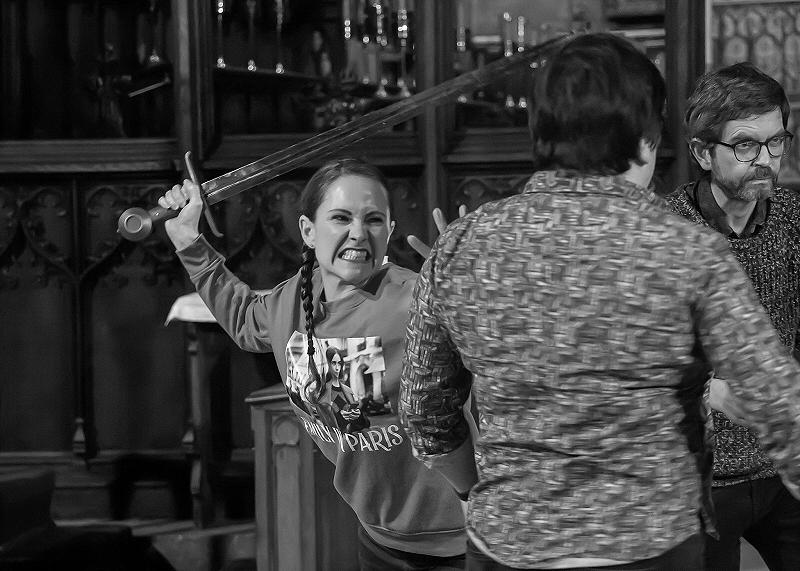
Anyhow, here’s our Becky below (as Simon Peter) ‘meaningfully showing it’ at rehearsal with a flipping big sword. Spoiler! Our Gethsemane scene features a brilliant fight sequence choreographed by amazing professional fight director Kaitlin Howard.
Here’s where I was going with this.
You don’t need to have been Jesus, kneeling in a garden, crying his eyes out, pouring his heart out, to know about abandonment, and to show to an audience what abandonment looks like. I’ve known how it’s been to feel abandoned in my life. How about you? I’ve known how it’s felt to not want to have to endure something, to not want to go through an ordeal. How about you? I’ve known how it’s felt to want something stark, painful and terrifying taken away from me. I’ve known how it’s felt to not understand the reason why I must do the something stark, painful and terrifying. How about you?
You don’t have to believe that Jesus was the son of God to believe that Jesus knew about human suffering. It’s beyond doubt that Jesus experienced human suffering himself. He’s been where we’ve been, felt what we’ve felt. So much more besides.
Gethsemane is human suffering writ large, and the abandonment that Jesus feels is the worst abandonment of all. To feel, in his agony, that God is absent. To feel utterly alone in the universe. I think that many of us will have felt this way in our darkest times. Such a desperate speech.
It seems to me that the themes touched on in the Gethsemane scene (and indeed across the whole play) are so universal as to be relatable to everyone, wherever we stand spiritually.
As James says in the Left Lion article: ‘whether people believe or not, the story touches on a profoundly emotional, spiritual level … the themes of sacrifice, love, betrayal, and desperation – it has it all.’
On the subject of ‘betrayal,’ that’s the mighty Ade Andrews (aka. Ezekial Bone, Nottingham’s own Robin Hood) as Judas Iscariot giving me a traitorous peck on the cheek in the picture below. It’s to Gethsemane, of course, that Judas Iscariot leads Roman soldiers to arrest Jesus, identifying his master by kissing him on the cheek.
The betrayal of Jesus is a beautifully directed sequence, and Ade does what he does wonderfully in it. At this point I’m under instructions not to give too much away about how the action plays out. Don’t worry, theology buffs! Judas still betrays Jesus! We haven’t messed with the gospel!
But you might want to rain check those boos and hisses in the light of what you see. Let’s just say what you see might defy expectations.
You didn’t want something safe and fluffy, did you?
Thanks, as ever, for coming along. Next up for Jesus? The trials and the crucifixion.










 Simon Carter
You must be logged in to post a comment.